Socials

Showing posts with label Robin. Show all posts

10 April 2026

Grant Morrison's Batman Annotations: Batman #658

The Give Me Comics or Give Me Death podcast is available from all your usual podcast providers, or see all episodes here

See the index for all entries in these Batman annotations here 


Batman & Son Part 4: 'Absent Fathers'


The title of Absent Fathers has multiple references in this issue, and indeed is a theme throughout the run.  The main reading of it is, of course, Bruce’s absence from Damian’s life up to this point and, the implication made at the end of the issue, that it is an absence that will continue.  There is also Bruce’s absence as a father from Tim Drake (who at this point had been adopted by Bruce).  Not only is he dealt a severe beating in his absence (by his ‘brother’), Batman then concludes the adventure without him.  Finally, there is the (literal) absence of Talia’s father, Ra’s al Ghul, who casts a shadow over the whole arc.  This portends his return in the forthcoming crossover The Return of Ra’s al Ghul

A fairly simple issue here, as we wrap up the Batman & Son story.  Batman arrives back at the Batcave after last issues events to find Tim Drake bludgeoned on the floor.  He rescues Alfred and has him patch up Tim, while admonishing Damian.  His newfound son tells Bruce that his mother, Talia al Ghul, will be at Gibraltar where she attempts to ransom off the Prime Minister’s wife in exchange for the military garrison there.  Batman, with Damian in tow, arrives in the nick of time and defeats her ninja Man-Bats.  Batman and Talia confront each other until the British navy destroys the submarine they are all on - leaving Batman as the apparent sole survivor.

Page 1

A great page that acts as a recap of where we are - the Prime Minister’s wife has been kidnapped by Talia, who is using Man-Bat serum to create an army of ninja Man-Bats.  Her final line “As a wife and mother, I’m sure you’ll understand” lay out the personal reasons for her whole diabolical plot - issues she will discuss with Batman in a few pages time

Page 4

Panel 3 - Damian is wearing Jason Todd’s Robin costume he took from display in the Batcave, but along with his Assassin’s League cloak. He still has a foot in both camps.  He has yet to shed his Assassin’s clothing and embrace his role as Batman’s son.


Page 7

Panel 4 - Damian is no longer in the Robin costume, but back in his League of Assassins white top.  This would make sense, as Batman would not allow him to don his sidekick’s costume as this stage.  However, there appears to be no break in the scene from the previous page where Damian is seen in the Robin outfit.  My assumption is that the last panel on page 6 was coloured incorrectly.  Here he tries to dispel Batman’s suspicions of him as a weapon of Talia sent to disrupt his operations by telling him where she is.  It’s later revealed that was exactly Talia’s plan - so he was being used by her all along, even though he didn’t realise it. 

Page 9

Panel 5 - Batman stops the destruction of Kirk Langstrom’s serum by his long-suffering wife, as he will use it as an anti-dote for Talia’s ninja Man-Bats at the end of the issue.  He will also return to Langstrom’s serums for assistance in his final showdown with Talia a few years down the road at the climax of Morrison’s Batman.


Page 11

Panel 1 - Bat-Rocket!  Here is a sign from Morrison that he re-orienting Batman away from the street level vigilante to globe-trotting super-hero.  


Page 13

Panels 2-3 - Talia is wanting to trade the wife of the Prime Minister’s wife for control of Gibraltar, which is indeed the ‘perfect tactical outpost’.  Positioned at the southern tip of Spain, it is a tiny (2.6 square miles) British colony.  Based around the Rock of Gibraltar, a large hill and fort, it overlooks the Strait of Gibraltar, the narrow waterway that separates the Atlantic Ocean from the Mediterranean Sea, and Europe from Africa.   

Page 15

Panel 2 - One of the ninjas is injecting himself with some kind of serum.  We could assume he’s just another one of Talia’s faceless, nameless henchmen.  Yet here he is given a name - Bulu - suggesting there is something different about him.  There are a coupe of meanings to the name that might be of relevance here.  It is a surname in the central and southern African Bantu-speaking people meaning strong or brave, and he is about to develop significant strength, just off the coast of Africa.  More tenuously it is the name of the underworld in Fijian mythology - and Morrison regularly uses underworld allusions for Batman.

Page 16

Panel 1 - Bulu has been transferred into a Man-Bat.  However, just like the oddity of being the only one named, we see that he is physically different from his brethren; larger, stronger, and more monstrous.  This seems to suggest Talia has been able to ‘improve’ the Man-Bat concoction and demonstrates her knowledge of genetic engineering.  This hints at the creation of the hulking nemesis, the Heretic, who wreaks havoc in Morrison’s closing storyline. 

Page 20

We get Talia’s explanation for her motives.  She wants her and Bruce to raise Damian to rule the world.  Obviously Batman cannot agree to this.  His rejection of her is the catalyst for the final third of Morrison’s run, as she seeks revenge in the worst possible way.  Poor Damian revealing he doesn’t want to choose between them, is placed in the position of every child who’s parents can’t work it out - despite being trained a world conquering assassin, he’s just a little boy who wants his family to be together.  Interestingly when Talia says ‘ours is a love story’, Bruce doesn’t deny this but states ‘it was a long time ago’ - adding more confusion as to whether Damian was conceived consensually, as earlier Bruce had claimed he was drugged.

Page 21

Panel 4 - Moments before the submarine explodes Talia activates something on her wrist.  Some kind of teleportation device?  Whatever it is, her and Damian survive.

Page 23

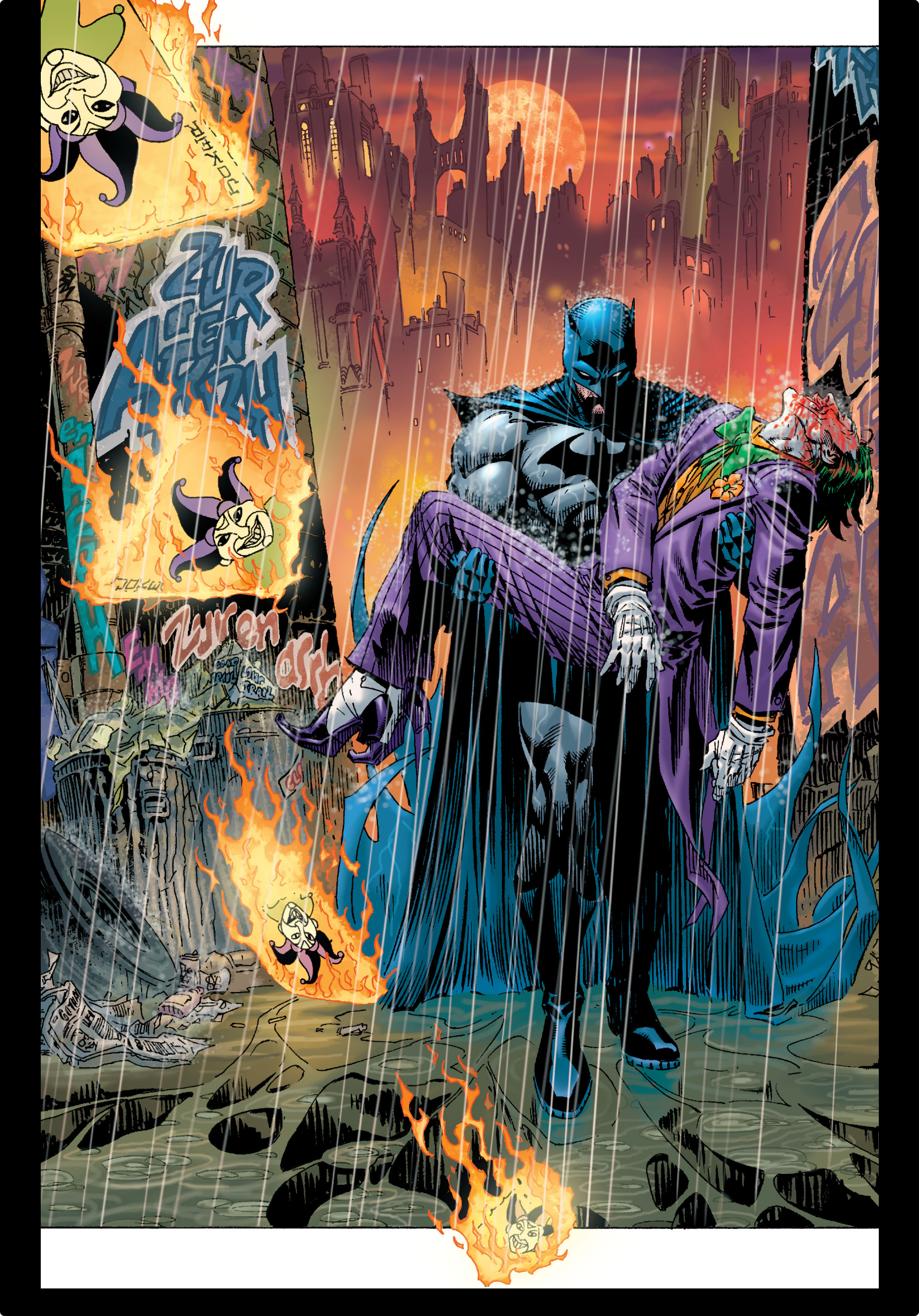
Obviously Batman doesn’t need teleportation devices to survive - he’s Batman!  Batman stands here holding Damian's cowl and foreshadows his own ‘death’ in Batman #681, where Dick Grayson stands holding Batman’s cowl overlooking the water and fire.


30 December 2025

Grant Morrison's Batman Annotations: Batman #657

The Give Me Comics or Give Me Death podcast is available from all your usual podcast providers, or see all episodes here

See the index for all entries in these Batman annotations here 


Batman & Son Part 3: 'Wonderboys'


The title is a play on the nickname for Robin of ‘the boy wonder’, pluralised here as we get two Robins in this story.

This fairly pedestrian issue serves primarily to introduce us to the personality of Damian, Batman’s newly revealed son.  He first challenges Batman to a fight, brushes off Tim Drake (the current Robin) when introduced, and acts the spoilt brat with Alfred.  When Batman is called out into Gotham’s sewers to deal with a kidnapping situation orchestrated by The Spook, Damian breaks out of Wayne Manor to ‘help’ and beheads the villain.  Upon returning to the Batcave he confronts and beats up Robin, before meeting his father on a rooftop and declaring himself the new Robin.
 

Page 1

Panel 3 - With his bat wing shaped eyebrows, Damian seems destined for the Wayne family.


Page 2 & 3

The Batcave.  Most artists with a run on Batman get to their Batcave shot.  Everyone seems to give it a different look and layout, but there are usually some consistent elements such as we see here; a bat-plane, a bat-boat, and trophies from Batman’s past adventures.  Given the premise of Morrison’s story is that all past continuity is canon, it’s no surprise we get some of these souvenirs:

  • The giant dinosaur is an animatronic construct originally from ‘Dinosaur Island’, a theme park, and first appeared in Batman #25 (1946).  It often ‘comes alive’ to fight off intruders to the Batcave,
  • Despite coins being usually associated withe long-standing villain Two-Face, the giant penny in the Batcave is actually a memento from Batman’s encounter with the Penny Plunderer in World’s Finest Comics #30 (1947).
  • The huge joker playing card is, unsurprisingly, a souvenir from Batman’s run-ins with arch-nemesis the Joker.  It originally appeared hung on the Joker’s wall in Detective Comics #114 (1946), in a bizarre story that revolves around acrostic poems (no, really!)

  • In the glass displays are costumes from two other members of Batman’s history - Mr Freeze’s helmet and, what looks like, the outfit of either the Roman themed Batman ally the Legionary (who is reintroduced in a few issues time) or Maxie Zeus the Greek mythology obsessed supervillain. 

Page 6

Panel 1 - Our and Damian’s introduction to Tim Drake, the third character to take on the Robin moniker and role as Batman’s sidekick/protégé, he first appeared in 1989’s Batman #436.  Drake actually worked out the true identities of Batman and Robin (Dick Grayson at the time), and was eventually picked to become Robin after the death of Jason Todd (the second Robin).  More of a detective than previous Robins, he’s an obvious choice to help introduce Damian, as their personalities are almost complete opposites.  It’s not long before Morrison moves Drake out of the larger story, so the spotlight can remain on Damian, however he plays a significant role in looking for Bruce Wayne after his ‘death’ - though mostly in other non-Morrison written Batman related comics.

Page 8

Panel 4 - These fancy alternative Batman costumes appear to be based on action figures - possibly from the Batman: The Animated Series line - however, despite trawling the internet I’ve been unable to definitively tie them to specific figures.  Anyone who can - let me know!

Page 9

Panel 1 - “What about us?”  Tim’s concern about Batman’s apparently new-found son is particularly acute because he had just been legally adopted by Bruce in Batman #654, the last issue before Morrison took over.

Page 11

Panels 3 &4 - Damian’s brattish tempter tantrum is only ended when Batman expresses anger, authority, and the codes of the martial arts.  This works because that is how Damian has been raised, and is what he’s used to.  However, throughout Morrison’s run Damian only begins to grow as a character and leave his horrific upbringing behind him when Batman, and the Bat-Family, being to treat him differently and show him there is an alternative to the way he was raised. 

Page 12

Panel 1 - The Spook - real name Val Kaliban - is a minor, rarely seen, Batman villain who made his first appearance in Detective Comics #434 (1974).  A world-class escape artist who uses those skills, along with a combination of special effects, to portray himself as a real ghost to commit crimes - predominately breaking other criminals out of prison via the underground network of tunnels that feature in this issue.  Having only made half a dozen appearances since the 70s, he’s another example of Morrison digging deep into Batman’s past.  

Panel 2 - “Over my dead body, Mister Mayor!” The Spook foreshadowing his own death a couple of pages later.  At the time of writing he remains dead, and with his bit-part history one suspects this may will be the last we see of him.  


Page 15

Panel 4 & 6 - Damian escapes the Batcave by deducing the key code from Alfred’s fingerprints, and then mimicking Tim perfectly to override the voice activated locks.  We're being shown that behind the immature exterior, Damian does possess skills well beyond his years.

Page 16

Panel 6 - Confusingly, Damian now suggests he escaped his room by killing Alfred and taking the key.  Alfred is later revealed to be fine, so how he got the key and how he really escaped is left unexplained.  

Page 18

Panel 1 - More mementos in the Batcave.  On the left is the Robin outfit worn by Jason Todd, the second Robin who was murdered by the Joker.  Next to it is the proto-Batman costume worn by Bruce’s father to a fancy dress party in Detective Comics #235 (as discussed here), and soon to be worn by Dr Hurt in Batman R.I.P.


Page 21

Panel 5 - ‘There’s a new Robin now’.  Not only does this panel herald Damian as the new Robin, but Tim’s removal from the role and adoption of the Red Robin moniker after Batman’s disappearance.  More tragically, in taking Jason Todd’s costume, Damian has damned himself to the same fate as it's previous wearer - death. 


9 July 2025

Grant Morrison's Batman Annotations: Batman #655

The Give Me Comics or Give Me Death podcast is available from all your usual podcast providers, or see all episodes here

See the index for all entries in these Batman annotations here 


Batman & Son Part 1 - 'Building a Better Batmobile'


Having seemingly won the battle over supervillainy in Gotham, Batman is persuaded to spend more time as Bruce Wayne.  Flying over to London to attend a fundraiser, he is drawn into a plot by an unknown woman involving Man-Bat and a mysterious child.

Page 1

 
The man falling from the building, having suffered poisoning from Joker gas, is Jim Gordon.  He made his first appearance in Batman's first ever comic, Detective Comics #27, and has been an ally and sometime confidant of Bruce Wayne and Batman ever since.  Generally holding the position of Commissioner of Gotham's police department, he has over the years been a Detective, a Captain, and retired.  It is often implied that he knows Bruce is Batman, but keeps the secret to himself - and he would have to be the worst police detective of all time not to have figured it out.  He is the father of Barbara Gordon, one-time Batgirl and then superhero information broker Oracle.  Despite the longstanding and deep relationship the character has with Batman, he plays a fairly minor supporting role in Morrison's Batman run.  

Page 2 & 3

 
A triumphant Joker leans over an apparently dead Batman with his bloodied crowbar.  We will shortly see that this isn't in fact Batman (nor is he in fact dead), but in the first pages of the run Morrison is already foreshadowing not only the 'death' of Batman that occurs later on, but their use of the crowbar (which is the weapon with which the Joker killed Jason Todd, the second Robin) also anticipates both the return of Jason Todd and the death of another Robin.  

The representation of the Joker here is very traditional, including the Joker-faced helicopter, and sets the scene for the Joker's own story of transformation.  He's bragging of killing Batman in front of a load of vulnerable disabled kids, to emphasise both his evilness and his absurdness.  Though his gloating of Batman's apparent death does seem at odds with his commentary in Batman R.I.P. that he and Batman need each other, and that his aim is Batman's psychological, not physical, destruction.  


Page 4

 
Panel 6 - The obvious indication that this isn't the real Batman, as Bruce Wayne doesn't use guns or kill.  Rules he would actually break during this run as part of Final Crisis where he shoots and 'kills' the god Darkseid.


Page 6

 
The first appearance of the phrase 'Zur En Arrh' which will reappear in the next few issues graffitied around Gotham City.  This is a trigger phrase implanted in Batman's head by our principal antagonist, Dr Hurt, intended to cause Batman's psychological collapse.
 
We also see here the bloodied Joker after being shot in the head.  Later, we will learn that the bullet to the middle of his forehead didn't kill him, but does lead to his transformation into a new version of the character.


Page 9

 
Panel 3 - Gordon says the Batman who Joker thought he had killed was an ex-cop who "just snapped".  In fact he is police officer Josef Muller, one of the 3 'ghosts of Batman', that have been manipulated by Dr Hurt.
 
Panel 5 - A key set up for Batman R.I.P. is Gordon's comments here that the newly revitalised Batman (following the Thogal ritual - see here) has essentially cleaned up Gotham.  This handily gives him space to mentor his son Damian - who at this stage he is unaware of - and pursue a romantic relationship with Jezebel Jet (yet another part of Dr Hurt's plan).  
 

Page 13

 
Panel 1 - Tim Drake joins the party.  He made his first appearance in Batman #436 in 1989.  Tim is the third person (child) to take on the role of Batman's sidekick, Robin.   He gets the gig after impressing Batman by using his detective skills to identify Bruce Wayne and Dick Grayson as the original Batman and Robin - a feat that makes Jim Gordon look even more useless, if he hasn't ever figured it out (see above).  A little unfairly, he's relegated to a bit part in Morrison's run, especially given the other Robins get time to shine; Dick Grayson becomes Batman for a while, Damian then takes over from Tim as Robin (and is a key character throughout the series), and Jason Todd gets a featured story and then a redemption arc. After Bruce Wayne's 'death' Tim adopts the new moniker of Red Robin, and his most crucial role is his instance and investigation into his belief that Bruce is still alive.  Notice he enters the Batcave here via a fireman's pole, a nod to the 60s Batman TV series.   


Panel 4 - The title of this issue's story is 'Building a Better Batmobile', and whilst that's really a metaphor for building a better Batman - Morrison's overall mission - we can see here it can also be taken literally. 

Page 14

 
Panel 2 - A perfect encapsulation of both Alfred and Bruce here; Alfred's care and attention even extends to the wild bats living in the Batcave, and Bruce - with his Batman tunnel vision - doesn't even notice.
 
Page 7 - A reiteration here that following the Thogal ritual, Batman returned so energised he ended the supervillain threat in Gotham (temporarily at least).
 

Page 15

 
The captive woman is Francine Langstrom, wife of Kirk Langstrom, aka Man-Bat - more on him below -  and despite being the damsel in distress here, has over the years transformed into She-Bat due to Kirk's serum that is being demanded by her kidnapper.  She made her first appearance in 1970's Detective Comics #402.
 
The clues to the villain's identity are all here; she's accompanied by ninjas and scientists, is using poison, has the long nails and pouty lips of a femme fatal, and refers to Batman as "my darling detective".


Page 16

 
Panel 4 -  Dr. Robert Kirkland "Kirk" Langstrom, a zoologist who specialises in bats, is better known by his alter ego Man-Bat, and made hist first appearance is Detective Comics #400 in 1970.  Langstrom developed a serum that turned him into a half-human, half-bat hybrid.  Sometimes portrayed as a villain, sometimes as an anti-hero, his serum has been used by, and on, many other characters over the years (including Batman).  Whilst Langstrom himself doesn't really feature in Morrison's Batman run after this first story arc, his serum, and those who have taken it, do continue to play an important role - particularly in the finale of Batman Incorporated.


Page 19 & 20

 
Morrison is laying out their vision here; taking the role of Alfred they're telling Batman that he's been too serious for too long, and now is the time to let Bruce Wayne back into the picture, to make Batman human again.  
 
Panel 6 - Alfred brings up the names of some of Bruce Wayne's previous girlfriends:
 
  • Kathy Kane was introduced after publication of the controversial book Seduction of the Innocent (1954) by Frederick Wertham, which suggested comic books were responsible for juvenile delinquency.  One of the many hysterical accusations was that Batman and Robin were in a homosexual relationship, and promoted homosexuality (which was obviously seen as a 'bad thing' in 50s America).  Kathy was brought in to be the very-much heterosexual love interest for Bruce, and as the first Batwoman, making her debut in 1956's Detective Comics #233.  Absent from continuity for many years, Morrison brought her back into the fold to play a significant part in Batman Incorporated.
  • Julie Madison made her debut way back in 1939's Detective Comics #1939, and has the honour of being Bruce Wayne's first romantic interest.  She was an actress, and actually got engaged to Bruce before breaking it off.  She was basically written out of continuity, until being reintroduced by Scott Snyder in 2011.
  • Vicki Vale made her debut in Batman #29 in 1948.  She is a journalist who has popped up throughout Batman continuity as a love interest - albeit being married to someone else at one point.  Despite not being used by Morrison, she does play a big part in Battle of the Cowl and Bruce Wayne: The Road Home, comics that tie into the main story but are penned by other writers. 
  • Silver St. Cloud first appeared in 1977's Detective Comics #470 as a socialite who dates Bruce Wayne, and actually figures out that he is Batman.  She has only made a handful of appearances since her debut, though she did pop up in the improbable but entertaining Batman/Elmer Fudd crossover.
The talk about past girlfriends also sets the scene for Bruce's next one: Jezebel Jet, who he (and we) will meet next issue.
 

Page 22

 
Panel 1 - Alfred wants to catch up in the latest Artemis Fowl book.  Written by Irish author Eoin Colfer, the series of children's novels features an elven police force facing off against the titular criminal mastermind.  You’d have thought he had enough of the fantasy crime fighting in his day job. 

Panel 2 - Given the scene takes place at an African fund-raiser, that must be Bono on the bottom TV screen!  Of course, U2's lead singer has a Batman connection - their song Hold Me, Thrill Me, Kiss Me, Kill Me, as well as being an absolute banger, was featured on the soundtrack of the Batman Forever film.  Bono was originally supposed to have a part in the film - as his 90s alter-ego MacPhisto - but the plan fell through, which is probably for the best.


Page 23

 
The ninja's surrounding Mrs Langstrom from earlier have now been subjected to her husband's serum, and are revealed as a new menace - Ninja Man-Bats!  The mysterious woman will be properly introduced next issue, as will the child-sized figure hidden in shadow who - unbeknown to even Grant Morrison at the time - would go on to be become a key and beloved character of the Batman universe. 


28 May 2025

Grant Morrison's Batman Annotations: 52 #30 & 47

The Give Me Comics or Give Me Death podcast is available from all your usual podcast providers, or see all episodes here

See the index for all entries in these Batman annotations here

The weekly series 52 span out of the Infinite Crisis comic/event, following which the holy trinity of DC Comics - Batman, Wonder Woman, and Superman - look a year-long leave of absence (hence the title, it covered 52 weeks in the DC universe in 'real time').   At the conclusion of Infinite Crisis Bruce tells the other two-thirds of that trinity that he intends to 'retrace the steps I first took when I left Gotham. I'll be rebuilding Batman.  But this time it's going to be different....I'm not going alone.'  Accompanied by (at that time the only) Robins (Dick Grayson and Tim Drake), this sets up the premise of Morrison's mission for Batman - to turn him from the dark violent soldier-vigilante character he had become into a brighter better-adjusted superhero.
 

52 #30


This issue catches up with the Batman family and what they're up to during this period, but also clarifying where they stand in the New 52 continuity. Much of the story concentrates on Batwoman - later with Nightwing - and her attempts to tackle Intergang and their leader Mannheim.  However, we also get Morrison's pages featuring Batman, Nightwing, and Robin.  The latter two are on the trail of Batman, who has disappeared into the desert, whilst also discussing whether Bruce has "cracked".  We then find Bruce wandering the desert, when he is set upon by the Ten-Eyed Men of the Empty Quarter, who he allows to attack him in order to kill his 'demon'.

The Cover

 
Based on 14th and 15th century altar pieces and paintings of the Archangel Michael fighting Satan (see below), it here represents Bruce Wayne slaying his demon - the dark Batman personality that he had become.  There is also the clear foreshadowing of the conflict to come when Batman will fight Dr Hurt who may, or may not, be the Devil himself.  Furthermore, the biblical account of the Archangel Michael fighting Satan occurs during the War in Heaven, when Lucifer rebelled against God and was cast down to Earth.  This is essentially the start of Final Crisis, where the New Gods fight their own war and 'fall' to Earth, and is a key part of Morrison's Batman story.


Page 1

 
It's so appropriate for Morrison's Batman saga to start right back at the beginning.  Here we have early Batman in his original costume (as seen below in Detective Comics #27, his first appearance).  "Things started out so well" goes the Dick Grayson narration.  This doesn't quite fit the story Morrison is telling, because early Batman was pretty dark and violent, before becoming more light-hearted with the introduction of Grayson himself as the first Robin.  


Page 2

 
Here we go on a quick tour through the history of Batman.  Grayson's narration continues, "when you think about everything that happened - it's too much for any man.  Even the strongest".  So on just the second page of Morrison's Batman project the basis of Batman R.I.P. is laid out - all the crazy and traumatic events from Batman's continuity all happened, which begs the question, what would that do to a man?  
 
Panel 3 - Dick Grayson moving out and going to college (Batman #217 - 1969), leaving Batman without the key anchor to his humanity.  Robin's introduction had forced him to become a father figure and a role model with responsibilities. 
  
Panel 4 - The first appearance of Jason Todd in the new Post-Crisis on Infinite Earths continuity (Batman #408 - 1987).  Batman discovers the street orphan stealing the Batmobile's wheels, and recruits him as his new Robin.
 
Panel 5 - Jason Todd's tenure as Robin does not go well.  Here we see Batman carrying Jason's lifeless body after he was beaten to death by the Joker.  In reality, this was the result of a phone-in stunt by DC Comics, where readers voted whether the character should live or die.  The fans, who never took to the surly and angry Robin, narrowly voted to kill him off 5,343 votes to 5,271.


Page 3


The Batman history tour continues.
 
Panel 1 - Joker shooting, and crippling, Barbara Gordon (Batman: The Killing Joke - 1988).  In the post-Crisis continuity, Barbara had never been Batgirl, and was the niece/adopted daughter of Commissioner Jim Gordon.  Following her paralysis, she would go on to adopt the Oracle moniker and become a provider of intelligence support for various super-heroes.
 
Panel 2 - Bane breaking Batman's back (Batman #497 - July 1993) which would put him out of action for some time.  Batman anointed Jean-Paul Valley (aka Azrael) to take his place.  He turns out to be dangerous and murderous, and is taken down by Batman once his physical recovery is complete.  Interestingly, despite the obvious parallels with Morrison's story, it is barely referenced by them.  

Panel 3 - The panel isn't particularly clear, but it appears to be representing the Cataclysm and No Man's Land storylines (various Batman titles - 1999), in which Gotham City is struck by a massive earthquake.  Following the evacuation and abandonment of the city by the federal government, Batman must try and reclaim a lawless city overrun by gangs and super-villains.
 
Panel 4 - Of course in comics N.E.R.D. (No-one Ever Really Dies), so here we have Batman fighting with the new violent Gotham vigilante The Red Hood, only to discover it is his former Robin, Jason Todd, who has returned from the dead (Batman #641 - 2005).
  
Panel 5 - Tim Drake (the third Robin) and Batman arrive at Tim's father's house too late, and find his body following his murder by Captain Boomerang (Identity Crisis #6 - 2004)
 
Panel 6 - I'm not sure what this panel is depicting.  It potentially looks like Batman holding a gun to the head of Joe Chill (sometimes identified as the murderer of Bruce Wayne's parents), though I'm not aware of any specific comic that occurs in.  Any suggestions welcome!


Page 4 

 
Panel 2 - Tim Drake suspects Bruce wants him and Dick to become the new Batman and Robin, foreshadowing the new dynamic duo in Batman and Robin - though it won't be Tim in the Robin role.
 

Page 14

 
Panel 1.  "My soul is black and I feel sick.  I've lost my resolve."  This is the in story explanation for Morrison's revision of the charatcter.  Bruce himself has had enough of the dark and moody Batman.  It's hampering him.  
 

Page 16

 
Panel 5 - Bruce is making clear his agenda.  He considers the person Batman had become a 'demon' that needed to be killed, and he had been corrupted by "dark, fearful, paranoid urges".
 
Panel 6 - "Batman is gone".  Of course, he isn't, but Morrison is saying that version of Batman is gone, and a new version is coming.  It also anticipates Bruce's death/disappearance in Batman R.I.P. and Final Crisis.


52 #47

Most of this issue is given over to the ongoing efforts of Batwoman, Nightwing, and The Question, to battle Intergang/the Crime Bible.  We also get updates on Animanl Man, and what's going down in Metropolis - all part of the ongoing 52 storyline.  However, we do get a few pages from Morrison continuing the set-up for their Batman run by undergoing the The Thörgal ritual.
 

Page 1

 
Panel 1 - Nanda Parbat - 'the mountain of delight' in Hindi, is a fictional city high in the mountains near Afghanistan and Pakistan.  It is home to an order of monks and watched over by Rama Kushna - a godlike being.  It is clearly influenced by Shangri-La, the famous fictional secret Tibetan valley that also influenced Marvel's Kunlun (as seen in Iron Fist).  Nanda Parbat is featured again in The Resurrection of Ra's al Ghul storyline early in Morrison's run.
 
Panel 2 - "Bruce isn't my Dad."  The timeline is a bit confusing here as Bruce had actually adopted Tim about a year earlier in publication time, however that occurred in the One Year Later storyline which actually took place after the events of 52.  It also reminds us that Tim's real father was murdered, another dark chapter in Batman's history.
 
The monk explains to Tim - and the reader - that Batman is undergoing the Thörgal ordeal (often later referred to as a ritual) that will cause him to become changed.  It is explained that Bruce will spend seven days in darkness.  But it's worthwhile looking at the Thörgal ritual in more detail, as it is key to Batman R.I.P. 

Thörgal, or Tögal, is a Buddhist ritual, and according to The Tibetan Book of Living and Dying the aim of is to 'enable a person to actualize all the different aspects of enlightenment within themselves in one lifetime'.  This is Morrison's mission statement for the first third of their Batman run; every Batman story happened, so all these different aspects of Batman over the years are real and reflections of the same man.  Morrison intends to make a new, better, Batman, and that can only be achieved by reconciling these differing aspects of Bruce Wayne.  It is said that the ritual requires enormous discipline - and who has more discipline than Batman?  The ritual is practiced in a completely dark setting - in this case a cave, which of course echoes the place most readily associated with Batman.
 

Page 3

 
Panel 3 - "It's like an ordeal...of spiritual purification" - Bruce is purifying himself of the Batman he had become, he's using the ritual to shed the darkness that's increasingly dominated his life and personality.
  
Panel 6 - In the Thörgal ritual one experiences multiple visions - given the horrors that Bruce is trying to move past, it's not surprising he might see such things that would cause a reaction like this.  Note the shadows forming a Batman logo over his face.


Page 19

 
Panel 5 - The ritual is over and Bruce is reappearing from the cave, by moving the boulder blocking the entrance.  There are obvious links here to the resurrection of Jesus, signifying the resurrection of Batman from the dark 80s/90s character to someone more rounded.  Religious allusions are used throughout Morrison's Batman run.   


Page 20

 
Bruce emerges into the daylight, purified of his demons.  By putting a confident happy looking Bruce wayne at the front and the shadow of Batman behind him, we can now see that Bruce is in control of Batman now.


28 April 2025

Grant Morrison's Batman Annotations: Recommended Reading Part 2

The Give Me Comics or Give Me Death podcast is available from all your usual podcast providers, or see all episodes here

See the index for all entries in these Batman annotations here

In Part 1 of this recommended reading, I focused on the works by Grant Morrison that are particularly relevant to their Batman run.  Now it's the turn of other writers and artists.  Morrison reached back into the mists of time and used unexpected Batman stories for the basis of their epic - long forgotten tales, outlandish madcap stories that were excommunicated from continuity as they didn't 'fit' modern Batman, and plots and characters that neatly dovetailed with the saga that was to unfold.

Batman: Son of the Demon (1987)
Written by Mike W. Barr
Art by Jerry Bingham


This 1987 graphic novel is the purported origin of Bruce Wayne and Talia Al Ghul’s son, Damian Wayne, who plays a significant role in Morrison’s Batman run as a new Robin and (as shown in Batman #666 and #700) ultimately takes over the mantle of Batman.

There are major discrepancies though between the story itself and the version put forward by Morrison.  In Son of the Demon, Batman appears to genuinely have feelings for Talia – or at bare minimum, be attracted to her – and agrees quite happily to a relationship with her.  When she announces her pregnancy, he is delighted and prioritises the health of her and their unborn child over everything else.  When Talia tells him she has lost the baby, Batman seeks revenge on the man he considers responsible (Qayin, who was at one time a surrogate son for Talia’s father Ra’s al Ghul).  After leaving Talia (at her insistence) and returning to Gotham, he is clearly emotionally affected by the apparent death of his unborn child. As an epilogue to the tale, 9 months later, a baby boy is left on the doorstep of an orphanage and taken in by a childless couple.  Left with the child is the necklace that Bruce gave Talia during their time together.

Morrison significantly rewrites history.  When Talia asks Bruce if he remembers the night Damian was conceived, he replies, “I remember being drugged senseless and refusing to co-operate in some depraved eugenics experiment.”  No mention of the apparent miscarriage is made, and the inference is that Batman was unaware of Talia’s pregnancy.  Furthermore, rather than being adopted anonymously by a random couple, Morrison tells of Damian being grown in an artificial womb and genetically modified, then raised by the al Ghul organisation The League of Shadows to be a future conqueror of the world.  Damian says he was not ‘formally introduced’ to his mother until his 8th birthday, some two years before he meets his father. 

Batman: Son of the Demon was never particularly considered an in-continuity tale, even upon its release, and although the idea of the child from this story was used in alternative universes or stories set in the future, Morrison’s Batman was his first introduction in the ‘main’ continuity. 


Batman The Cult #1-4 (1988)
Written by Jim Starlin
Art by Bernie Wrightson

 
In this 4 issue mini-series – which clearly influenced The Dark Knight Rises movie – a cult made up of the homeless and hopeless of Gotham mass in the city’s sewers launching vigilante attacks on criminals and politicians alike.  There are clear links and influences of Morrison’s Batman run here.  Batman is drugged and brainwashed into joining the cult, which is echoed in the scheme of Dr Hurt in Batman R.I.P.  The cult leader is a seemingly immortal man obsessed with Gotham, traits shared not only with Dr Hurt but also Brother Manfred from Morrison’s Batman: Gothic.  However, Morrison specifically links their Batman run with The Cult as this series sees the introduction of Miagani tribe, an ancient Native America tribe that lived in area that became Gotham City, and in the caves that became the Bat-Cave.  All this also feeds into the general ideas that Batman has been subjected to drugs, gasses, and psychological attack, countless times over the years, and that the supernatural is an established aspect of Batman’s history.


Batman: Dark Kight, Dark City
Originally published in Batman #452-454 (1990)
Written by Peter Milligan
Art by Kieron Dwyer (and some lovely covers by Mike Mignola)

 
In this great little story Batman is led on a merry dance by the Riddler, who tricks Batman into committing a series of steps in a ritual to summon the demon ‘Barbathos’, culminating in the attempted sacrifice of Batman himself.  It is suggested that this demon has possessed the Riddler and has been guiding his actions all along.  The ending is ambiguous as it appears Batman releases the demon from where it has been trapped, along with the skeleton of the previous sacrificial victim, so despite surviving Batman may still have achieved the demon’s goals.  Batman then gives the victim a burial in the Wayne mausoleum, next to his parents. 
 
In flashback scenes we travel to 1793 where a group of men try to summon the same demon, via the sacrifice of the girl whose skeleton is found by Batman in the contemporary story.  This summoning takes place in a cellar adorned with satanic symbols, with the group led by a Jacob Stockman and including a young Thomas Jefferson.  A bat shaped creature appears – which the group assume to be the demon – causing the men to flee and trap the girl in with the creature, condemning her to death.


Morrison replays this scene in Batman and Robin #16 at the conclusion of The Return of Bruce Wayne storyline, as the revelations mount and the plot lines in place for the first two thirds of Morrison’s run come to conclusion.  There are however some key differences.  The demon being summoned is now referred to as ‘Barbartos’, named for a demon from The Lesser Key of Solomon, a grimoire from the mid-17th century.  This ‘demon’ plays a key part in Morrison’s story and is revealed to actually be the Hyper-Adaptor, a creature/weapon sent by the New God Darkseid to pursue Batman through time, and the driving force of the events of The Return of Bruce Wayne.  Furthermore, the sacrificial girl is not the only person left behind in the cellar as Stockman and friends flee – there is also Thomas Wayne, Bruce’s ancestor, who strikes a deal with ‘Barbartos’ granting him immortality.  Thomas Wayne will surface years later as Dr Hurt, the principal antagonist for the bulk of Morrison’s Batman run.


The Black Casebook  
 
Many of the plot points and characters that inform the first third of Morrison's run (often referred to as Batman R.I.P., but actually includes all the story up to and including those published under that title), are drawn from the oddball and bizarre Silver Age Batman comics that Morrison read as a kid.  As they don't fit the character Batman became - and certainly not the modern silver screen version - they have been airbrushed out of history by DC Comics.  They are not even available from their digital subscription service, DC Unlimited.  However, to coincide with Morrison's successful Batman run, some of these were published together in The Black Casebook.  Taking its title from Batman's own notes of his more esoteric adventures, it collected 12 otherwise unavailable tales.  A few of the stories are included just to give an idea of the type of story that inspired Morrison, or examples of when Batman came under psychological attack or subjected to mind-altering gasses and chemicals (all of which plays into Batman R.I.P.), but the notable tales are;
 
Batman #65 - 'A Partner of Batman' (1951)
Written by Bill Finger
Pencils by Lew Sayre Schwartz
 

Robin is out of action after breaking his leg.  Somewhat comically this comes not from battle with a super-villain, but Robin slipping on some oil and falling off a boat.  Enter: Wingman.  An unnamed masked adventurer from a 'northern European country' that fills in for Robin, whilst also being trained by Batman to be his counterpart in said unnamed nation.  Robin becomes increasingly upset from his mistaken belief that Batman is seeking a permanent replacement for him.  Wingman ends up being not particularly good, so much so that when Batman gets word that the gangsters they are taking on have decided to target the newcomer due to his inexperience, Batman and Wingman swap places.  Obviously, the caped crusader saves the day, dispatches Wingman off on his European assignment, and Robin returns to his rightful place as Batman's sidekick.
 
So we are introduced to the character of Wingman here, although in his preposterous bird costume he is very different from the version Morrison reintroduces as part of the Club of Heroes. The seeds are also sown here for the concept of Batman Incorporated as well - various Batmen, or agents of Batman, operating around the globe under his tutelage. 

Batman #86 - 'Indian Chief' (1954)
Written by France Herron
Pencils by Sheldon Moldoff
 
 
Interestingly, this story begins with Batman and Robin flying home in the Bat-Plane from a 'distant mission', a nod to one of the key messages from Morrison's Batman - that the character can have adventures away from Gotham City.  He's a global superhero and should act as such.  Batman and Robin land their plane after spotting a Bat-Signal created from smoke.  This leads to their introduction to Chief Man-Of-The-Bats and Little Raven, the secret identities of Native American father and son duo Great Eagle and Little Raven.   In a twist reminiscent of the Wingman episode, Batman and Robin take on the identities of their counterparts in order to bring down local gang leader Black Elk.
 
These two characters, again showcasing the notion that the concept of 'Batman' need not be limited to just one person, play important roles in the Club of Heroes and Batman Incorporated chapters of Morrison's run.   

Detective Comics #215 - 'The Batmen of All Nations' (1955)
Written by Edmond Hamilton
Pencils by Sheldon Moldoff
 
 
The Batmen of All Nations were reintroduced in Morrison's story as the Club of Heroes, and serve as a precursor of sorts to the idea of Batman Incorporated.   Here they are presented as crime fighters from around the globe influenced by Batman; The Knight and Squire from England (who sport lances whilst riding motorcycles adapted to look like horses), The Musketeer from France and The Legionary from Italy (both dressed exactly as you would imagine), The Goucho from 'distant South America' (who is a bolo expert), and Ranger from Australia (who initiates the story by asking for Batman's advice on his crime-fighting methods). 
 
There are a few nods to Morrison's Batman run in the tale of these Batmen helping foil an armoured car robbery; Batman seemingly dies after a house he walks into explodes (he faked his death, and reappears hidden in a money bag in the armoured car), and the apparent betrayal of one of the team - in fact, Legionary was replaced by the gang boss behind the robbery - foreshadowing Wingman's treachery in the Club of Heroes.
 
Detective Comics #235 - 'The First Batman...' (1956)
Written by Bill Finger
Pencils by  Sheldon Moldoff
 
 
It's no wonder that this Batman tale has been airbrushed out of history, as it casually ret-cons Batman's origins in significant ways - ways that Morrison was of course happy to take advantage of (remember, in Morrison's run everything from Batman's history happened).  We're treated to a flashback to when Bruce's father, Thomas Wayne is taken at gun point from a masked ball he is attending to treat an injured bank robber Lew Moxon.  Wayne Sr beats up Moxon and his hoodlums, and at their trial Moxon swears revenge on Bruce's father.  The two big twists here are that Moxon gets his revenge by hiring 'Joey' Chill to kill Thomas Wayne, in the infamous Crime Alley murder of Bruce's parents.  Usually named 'Joe' Chill, the character has appeared throughout Batman history as the Wayne's murderer, though he is ordinarily portrayed as a random mugger rather than a hitman.  Morrison treats him as such in the Joe Chill in Hell chapter of Batman R.I.P.  The other revelation is that Thomas Wayne attended the masked ball - which was themed 'flying creatures' - in a prototype Bat-Man costume (he's even referred to as a 'Bat-Man').   This outfit surfaces in Morrison's Batman as worn by Dr Hurt/Thomas Wayne, and by Bruce himself as he travels through time in The Return of Bruce Wayne.
 
World's Finest #89 - 'The Club of Heroes' (1957)
Written by Edmond Hamilton
Pencils by Dick Sprang
 
 
In this zany Silver Age team-up between Batman and Superman, the latter starts adopting an alter ego of Lightning-Man as a result of amnesia that occurs every time a fragment of a Kryptonite meteor orbits above Metropolis (it was the Silver Age!)  The background to all this is mysterious Metropolis millionaire John Mayhew, who creates a Club of Heroes to honour costumed crime fighters from around the world, so naturally we see the return of the heroes from The Batmen of All Nations.  Lightning-Man, and then when his identity is revealed, Superman, is elected chair of the club.  Morrison makes no mention of Superman (or indeed Lightning-Man) when they resurrect the Club of Heroes for Batman R.I.P. and Batman Incorporated, but the benefactor Mayhew plays a key role in the murder mystery of The Island of Mister Mayhew

Well after three blogs in preperation for the real deal, the next episode with being the annotations for real - albeit with the issues of 52 that lead into Batman R.I.P.  See you then, same Bat-Time same Bat-Channel. 

Mike