Socials

Showing posts with label Joker. Show all posts

9 July 2025

Grant Morrison's Batman Annotations: Batman #655

The Give Me Comics or Give Me Death podcast is available from all your usual podcast providers, or see all episodes here

See the index for all entries in these Batman annotations here 


Batman & Son Part 1 - 'Building a Better Batmobile'


Having seemingly won the battle over supervillainy in Gotham, Batman is persuaded to spend more time as Bruce Wayne.  Flying over to London to attend a fundraiser, he is drawn into a plot by an unknown woman involving Man-Bat and a mysterious child.

Page 1

 
The man falling from the building, having suffered poisoning from Joker gas, is Jim Gordon.  He made his first appearance in Batman's first ever comic, Detective Comics #27, and has been an ally and sometime confidant of Bruce Wayne and Batman ever since.  Generally holding the position of Commissioner of Gotham's police department, he has over the years been a Detective, a Captain, and retired.  It is often implied that he knows Bruce is Batman, but keeps the secret to himself - and he would have to be the worst police detective of all time not to have figured it out.  He is the father of Barbara Gordon, one-time Batgirl and then superhero information broker Oracle.  Despite the longstanding and deep relationship the character has with Batman, he plays a fairly minor supporting role in Morrison's Batman run.  

Page 2 & 3

 
A triumphant Joker leans over an apparently dead Batman with his bloodied crowbar.  We will shortly see that this isn't in fact Batman (nor is he in fact dead), but in the first pages of the run Morrison is already foreshadowing not only the 'death' of Batman that occurs later on, but their use of the crowbar (which is the weapon with which the Joker killed Jason Todd, the second Robin) also anticipates both the return of Jason Todd and the death of another Robin.  

The representation of the Joker here is very traditional, including the Joker-faced helicopter, and sets the scene for the Joker's own story of transformation.  He's bragging of killing Batman in front of a load of vulnerable disabled kids, to emphasise both his evilness and his absurdness.  Though his gloating of Batman's apparent death does seem at odds with his commentary in Batman R.I.P. that he and Batman need each other, and that his aim is Batman's psychological, not physical, destruction.  


Page 4

 
Panel 6 - The obvious indication that this isn't the real Batman, as Bruce Wayne doesn't use guns or kill.  Rules he would actually break during this run as part of Final Crisis where he shoots and 'kills' the god Darkseid.


Page 6

 
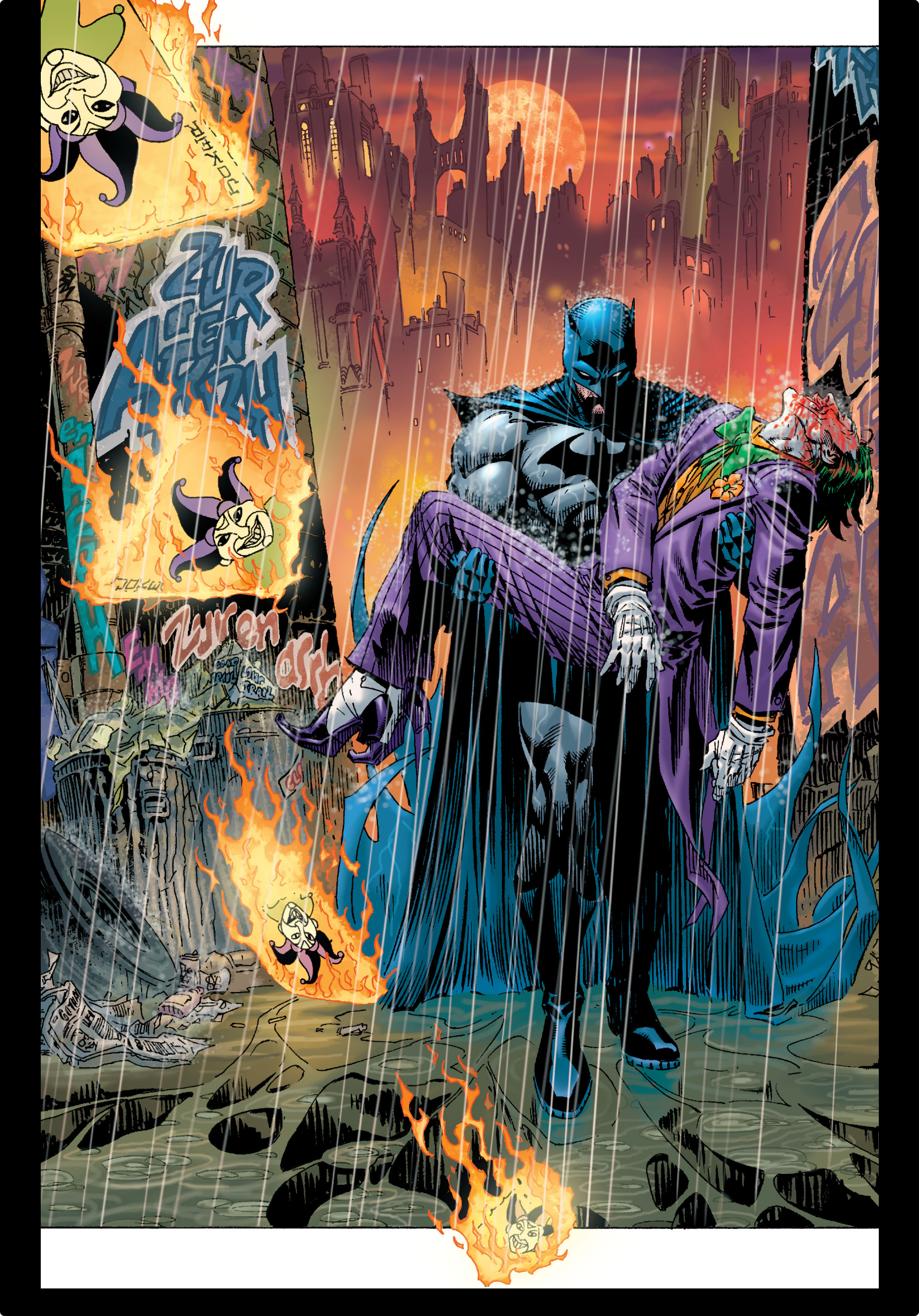
The first appearance of the phrase 'Zur En Arrh' which will reappear in the next few issues graffitied around Gotham City.  This is a trigger phrase implanted in Batman's head by our principal antagonist, Dr Hurt, intended to cause Batman's psychological collapse.
 
We also see here the bloodied Joker after being shot in the head.  Later, we will learn that the bullet to the middle of his forehead didn't kill him, but does lead to his transformation into a new version of the character.


Page 9

 
Panel 3 - Gordon says the Batman who Joker thought he had killed was an ex-cop who "just snapped".  In fact he is police officer Josef Muller, one of the 3 'ghosts of Batman', that have been manipulated by Dr Hurt.
 
Panel 5 - A key set up for Batman R.I.P. is Gordon's comments here that the newly revitalised Batman (following the Thogal ritual - see here) has essentially cleaned up Gotham.  This handily gives him space to mentor his son Damian - who at this stage he is unaware of - and pursue a romantic relationship with Jezebel Jet (yet another part of Dr Hurt's plan).  
 

Page 13

 
Panel 1 - Tim Drake joins the party.  He made his first appearance in Batman #436 in 1989.  Tim is the third person (child) to take on the role of Batman's sidekick, Robin.   He gets the gig after impressing Batman by using his detective skills to identify Bruce Wayne and Dick Grayson as the original Batman and Robin - a feat that makes Jim Gordon look even more useless, if he hasn't ever figured it out (see above).  A little unfairly, he's relegated to a bit part in Morrison's run, especially given the other Robins get time to shine; Dick Grayson becomes Batman for a while, Damian then takes over from Tim as Robin (and is a key character throughout the series), and Jason Todd gets a featured story and then a redemption arc. After Bruce Wayne's 'death' Tim adopts the new moniker of Red Robin, and his most crucial role is his instance and investigation into his belief that Bruce is still alive.  Notice he enters the Batcave here via a fireman's pole, a nod to the 60s Batman TV series.   


Panel 4 - The title of this issue's story is 'Building a Better Batmobile', and whilst that's really a metaphor for building a better Batman - Morrison's overall mission - we can see here it can also be taken literally. 

Page 14

 
Panel 2 - A perfect encapsulation of both Alfred and Bruce here; Alfred's care and attention even extends to the wild bats living in the Batcave, and Bruce - with his Batman tunnel vision - doesn't even notice.
 
Page 7 - A reiteration here that following the Thogal ritual, Batman returned so energised he ended the supervillain threat in Gotham (temporarily at least).
 

Page 15

 
The captive woman is Francine Langstrom, wife of Kirk Langstrom, aka Man-Bat - more on him below -  and despite being the damsel in distress here, has over the years transformed into She-Bat due to Kirk's serum that is being demanded by her kidnapper.  She made her first appearance in 1970's Detective Comics #402.
 
The clues to the villain's identity are all here; she's accompanied by ninjas and scientists, is using poison, has the long nails and pouty lips of a femme fatal, and refers to Batman as "my darling detective".


Page 16

 
Panel 4 -  Dr. Robert Kirkland "Kirk" Langstrom, a zoologist who specialises in bats, is better known by his alter ego Man-Bat, and made hist first appearance is Detective Comics #400 in 1970.  Langstrom developed a serum that turned him into a half-human, half-bat hybrid.  Sometimes portrayed as a villain, sometimes as an anti-hero, his serum has been used by, and on, many other characters over the years (including Batman).  Whilst Langstrom himself doesn't really feature in Morrison's Batman run after this first story arc, his serum, and those who have taken it, do continue to play an important role - particularly in the finale of Batman Incorporated.


Page 19 & 20

 
Morrison is laying out their vision here; taking the role of Alfred they're telling Batman that he's been too serious for too long, and now is the time to let Bruce Wayne back into the picture, to make Batman human again.  
 
Panel 6 - Alfred brings up the names of some of Bruce Wayne's previous girlfriends:
 
  • Kathy Kane was introduced after publication of the controversial book Seduction of the Innocent (1954) by Frederick Wertham, which suggested comic books were responsible for juvenile delinquency.  One of the many hysterical accusations was that Batman and Robin were in a homosexual relationship, and promoted homosexuality (which was obviously seen as a 'bad thing' in 50s America).  Kathy was brought in to be the very-much heterosexual love interest for Bruce, and as the first Batwoman, making her debut in 1956's Detective Comics #233.  Absent from continuity for many years, Morrison brought her back into the fold to play a significant part in Batman Incorporated.
  • Julie Madison made her debut way back in 1939's Detective Comics #1939, and has the honour of being Bruce Wayne's first romantic interest.  She was an actress, and actually got engaged to Bruce before breaking it off.  She was basically written out of continuity, until being reintroduced by Scott Snyder in 2011.
  • Vicki Vale made her debut in Batman #29 in 1948.  She is a journalist who has popped up throughout Batman continuity as a love interest - albeit being married to someone else at one point.  Despite not being used by Morrison, she does play a big part in Battle of the Cowl and Bruce Wayne: The Road Home, comics that tie into the main story but are penned by other writers. 
  • Silver St. Cloud first appeared in 1977's Detective Comics #470 as a socialite who dates Bruce Wayne, and actually figures out that he is Batman.  She has only made a handful of appearances since her debut, though she did pop up in the improbable but entertaining Batman/Elmer Fudd crossover.
The talk about past girlfriends also sets the scene for Bruce's next one: Jezebel Jet, who he (and we) will meet next issue.
 

Page 22

 
Panel 1 - Alfred wants to catch up in the latest Artemis Fowl book.  Written by Irish author Eoin Colfer, the series of children's novels features an elven police force facing off against the titular criminal mastermind.  You’d have thought he had enough of the fantasy crime fighting in his day job. 

Panel 2 - Given the scene takes place at an African fund-raiser, that must be Bono on the bottom TV screen!  Of course, U2's lead singer has a Batman connection - their song Hold Me, Thrill Me, Kiss Me, Kill Me, as well as being an absolute banger, was featured on the soundtrack of the Batman Forever film.  Bono was originally supposed to have a part in the film - as his 90s alter-ego MacPhisto - but the plan fell through, which is probably for the best.


Page 23

 
The ninja's surrounding Mrs Langstrom from earlier have now been subjected to her husband's serum, and are revealed as a new menace - Ninja Man-Bats!  The mysterious woman will be properly introduced next issue, as will the child-sized figure hidden in shadow who - unbeknown to even Grant Morrison at the time - would go on to be become a key and beloved character of the Batman universe. 


26 April 2025

Grant Morrison's Batman Annotations: Recommended Reading Part 1

The Give Me Comics or Give Me Death podcast is available from all your usual podcast providers, or see all episodes here

See the index for all entries in these Batman annotations here

Grant Morrison's epic Batman tale not only uses previous Batman stories for its inspiration, plot, and themes, it is predicated on the very fact that there are previous Batman stories - that everything that was printed did in fact happen.  From the sci-fi madness of the Silver Age to the gritty violence of the 90s, no story was out of bounds for Morrison or for Batman himself.  Grant does a decent job of weaving these parts of Batman continuity into its own story so that reading these earlier comics is not necessary to understand and enjoy it, but reading them - or at least these summaries! - will help illuminate the saga in ways that can only enhance it.

There is, admittedly, a lot to get through, so I've broken this down into two parts to make it somewhat easier to digest.  This first part will focus on other Grant Morrison work, and the second on comics by other writers.  Grant's comics have often tackled similar themes and ideas, and there is a crossover of many of these in most of their work for DC Comics, so in theory one could recommend reading the entire back catalogue of Morrison!  Don't worry, I'm not going to do that.  I'm going to focus on the most relevant comics to this run, particularly the key themes, plot points, and characters that shape it.


Arkham Asylum (1989)
Written by Grant Morrison
Art by Dave McKean

Probably the work that put Grant Morrison on the map – when released Arkham Asylum was the biggest selling graphic novel of all time (I believe Morrison claims it still is).  The multitudes who picked up this prestige format comic, with fully painted art by Dave McKean, must have been bemused by the story that they encountered.  Far from an action-packed adventure, or mystery solving plot, it is instead a slow labyrinthian examination of Batman’s psyche.  Batman arrives at the mental institution, Arkham Asylum, at the behest of the Joker who has taken its staff hostage.  Batmen enters the gothic mansion to try and resolve the situation.  In there he confronts a gallery of his rogues, each partly reflecting a piece of his own personality.  In flashback we also get the history of Amadeus Arkham, who founded the asylum, and this plays into why one of the doctors released the inmates from their cells initiating the whole escapade.  However, it’s not particularly clear whether these events actually happen or if they all occur in Batman’s mind.

Like much of Morrison’s previous Batman work, there are no specific connections made in his Batman run to this story. In fact, one of the more interesting points of his epic tale is that really only the Joker and Talia Al Ghul from his rogue’s gallery make appearances, other key characters from Arkham Asylum; Two-Face, Scarecrow, Clayface, Killer Coc, etc, are ignored completely.  However, there are some more thematic and symbolic connections:

  • The point of the story is to examine Batman, who he is and how he works, which is also ultimately the point of Morrison’s full Batman run but on a much larger scale.  Though the main difference is that here we take a look at Bruce Wayne from the inside of his head, whereas stories like Batman R.I.P. and The Return of Bruce Wayne use the actions of other characters and Bruce’s response to them to demonstrate the key elements of the Batman character.  

  • The key antagonist in Arkham Asylum is the Joker, who after forcing Batman to enter the asylum challenges him to a game of hide and seek – this is reminiscent of Batman R.I.P. and The Return of Bruce Wayne, where the Joker and Dr Hurt play out a metaphorical game of chess with each other, and where games, including dominos, are a recurring theme.   The story also brings up the idea that the Joker is not insane, but rather “super-sane”, constantly reconstructing himself in response to the ever-changing zeitgeist. Morrison explores this in much more detail in Batman R.I.P.  Furthermore, the Joker’s motivation here is not to attack Batman physically but psychologically, which is not only the motivation of Dr Hurt but also key to the conflict between him and the Joker.  


  • The Joker’s dialogue is presented in a different colour scheme to the other characters – in this case red with a white drop shadow – a technique that is used to particular effect in Batman R.I.P.

  • Much of Arkham Asylum revolves around the symbolism of the tarot, which is something Morrison uses in a lot of his work – they are strongly influenced by magic and have said one of their first real uses of it was giving a tarot reading to friends and acquaintances.  Whilst much less integral to the story than in Arkham Asylum there are allusions to the tarot in Morrison’s Batman run, most obviously in Batman Incorporated which reflects the Tower card – quite literally at the conclusion.  


Batman: Gothic
Originally published in Legends of The Dark Knight #6-10 (1990)
Written by Grant Morrison
Art by Klaus Janson

Morrison’s second Batman story is much more conventional than Arkham Asylum, and whilst it has less to say about Batman as a character than his other work, it does have some thematic links to his later Batman run.  The plot of Gothic is fairly straightforward, though its mysteries are slowly revealed with skill by Morrison.  Someone is killing off various mob bosses in Gotham.  The criminals, surprisingly, turn to Batman for help, claiming they know the murderer is a ‘Mr Whisper’ a child-killer who the believed they had murdered 20 years ago, and is now back wreaking his revenge.  It is subsequently revealed that ‘Mr Whisper’ is Bruce Wayne’s old headmaster ‘Mr Winchester’, and that Bruce was to be his next victim until his father pulled him out of the school furious at the corporal punishment being administered to his son.  To celebrate, Wayne the elder suggests they all go out to see a film – this turns out to be the infamous night Bruce’s parents are killed and his journey to becoming Batman begins.  Linking events in a story back to key moments in Batman’s life; his parent’s death, the bat breaking through his window, the death of Jason Todd, is something that is used repeatedly throughout Morrison’s Batman run.  


The mystery doesn’t end there – the true identity of the villain turns out to be Brother Manfred, a monk who sold his soul to the Devil in return for 300 more years of life.   The machinations of Whisper/Winchester/Manfred all turn out to be an attempt to cheat his way out of the deal, as his 300 years are now up.  Batman stops his plan, and the Devil – in the form of a nun – appears and takes his soul to hell.  Here, Morrison has clearly solidified the supernatural into the Batman mythos, and also established the Devil (and his deal making) as existing in the DC universe, which plays a key part in his later stories with both Dr Hurt and Damian.  Surprisingly though, despite one key premise of Batman R.I.P. being that all these stories happened, there are no overt references to Gothic or any suggestion that Dr Hurt and Brother Manfred share any connection.


JLA (1996-2005)
JLA #1-17, 22-31, 34-41, 1,000,000
JLA: Secret Files and Origins
Written by Grant Morrison
Art by Howard Porter (plus a few fill-ins issues by other artists)
JLA: Classified #1-3
Written by Grant Morrison
Art by Ed McGuinness 


Morrison’s seminal run on DC’s flagship title JLA (traditioanly called the Justice Leage of America, but not referred to as such in this title, given their more global scope) involved Batman as one of the key members of the team.  Morrison made sure all members got their moment in the sun, and as the team expanded this meant there was less room to comment on Batman specifically.  However, covering almost 50 issues they are several issues to take note of:
  • Morrison has often talked about superheroes in comparison with mythological gods and heroes – hence the title of his superhero analysis/autobiography book Supergods.  In JLA he takes this idea literally, portraying the team as the modern-day incarnation of the Greek god pantheon; Superman is Zeus the king of the Gods, The Flash is Hermes the god of speed, and Aquaman is Poseidon god of the seas, to pick the most obvious ones.  In this take Batman is Hades, the god of the dead and the underworld.  Hades was depicted by the Greeks as being cold and stern, traits typically associated with Batman – though part of Morrison’s aims for the character in Batman R.I.P thru Batman Incorporated was to break him out of such restrictive characterisation.  In Morrison’s Batman it’s suggested that death is a key component of the character and his mythos; not only was death of Bruce Wayne’s parents the catalyst for his transformation to Batman, but the death of those close to him (even if many are resurrected) is an almost routine occurrence and central to many Batman stories.  Hades’ realm of the underworld is also something often referenced by Morrison, most obviously in the metaphor of the Batcave, but also in the notion of Batman descending into the underworld to obtain knowledge or understanding.  As Batman, Dick Grayson does this twice in Morrison‘s run; when he goes deep into a British mine in search of a Lazarus pit to resurrect Bruce Wayne, and when he discovers previously unknown tunnels and ‘Batcave’ under Wayne Manor leading to the return of Bruce Wayne.
  • At the start of the JLA run Batamn tells the league that he’s only prepared to act in an “advisory capacity” because for him “Gotham comes first”.  This is the restriction – self-imposed in this JLA story, but meta-textually one that has been imposed on Batman by a succession of writers, particularly since the ‘dark and gritty’ version of the character from the late 80s onwards – and it is part of Morrison’s mission in his run to break Batman out of this geographical restriction. 


  • When the JLA are attacked by the villain The Key, the team are subjected to a neural virus that transports their minds to alternate lives.  In Batman’s alternative he is living in retirement with Selina Kyle (Catwoman), and the mantle of Batman has passed on to Tim Drake with Bruce Wayne Jr as his Robin.  This is a quite different outcome to the events in Morrison’s Batman run where Dick Grayson becomes the new Batman, with the son of Bruce and Talia Al Ghul, Damian, as his Robin – who in a potential future then goes on to become Batman himself.  #8 also sees the phrase "Batman and Robin can never die", which, in the slighty different form of "Batman and Robin will never die!", will feature several times in the Batman run - and is probably the overaching message of the whole story.


  • In the Rock of Ages storyline, which pitches the JLA against Lex Luthor’s Injustice Gang, the latter approach their conflict as “the corporate takeover of the Justice League’.  This, Luthor suggests, means employing the tactics of “identify their weak spots, destabilize their figureheads, headhunt the up-and-coming young hotshots’.  However, they are undone by Bruce Wayne’s superior corporate knowledge and tactics.  Not only is this echoed in that last third of Morrison’s run as Batman Incorporated take on Talia Al Ghul’s Leviathan organisation, Luthor’s tactics are employed by the latter during their war.  Morrison has repeatedly used the idea of corporations within their work; The Invisibles, Marvel Boy, and Seaguy, to name just a few.

  • In a possible future Batman confronts Darkseid and is struck by the latter’s Omega Effect beams.  Exactly the same thing will happen in Morrison’s Final Crisis which causes Batman to be thrown back in time, leading to the events of The Return of Bruce Wayne.  However, in the JLA story the beams are said to send Batman “out of time, out of space..beyond what the gods even know”.  The heroes save the day in their ‘now’, so that future never comes to pass, and we don’t get any follow up on this Batman’s fate – but it's interesting that Morrison re-ran the exact scene in Final Crisis but with (it appears)  different consequences.  


There are other connections to Morrison’s Batman in JLA – both specific and more general – though it also shares some of them with their other work through the years as well.  The climatic storyline in JLA builds upon several of the shorter arcs throughout the series, and many of the previously featured characters return.   The climax of The Return of Bruce Wayne builds upon the series to date, and ties together plot lines from the very first issue, though Final Crisis, and Batman and Robin.  Whilst Batman Incorporated acts in many ways as a fresh start as it moves on from the Joker and Dr Hurt, it ultimately ends with huge conflict between the characters that featured in Morrison’s opening arc Batman and Son, whilst also includes many of the characters (re)introduced along the way.  The JLA run also features characters from the New Gods – particularly in its final story – who are key parts of Final Crisis and its impact on Batman and his supporting cast.  Interestingly, whilst the Joker does appear in JLA as part of Lex Luthor’s Injustice Gang, he has little more than cameo appearances and has a much more traditional presentation that he will in Batman R.I.P. – Morrison has little to say here about the Joker, saving that deeper exploration for his longer Batman project.


52 (2006-2007)
Written by Grant Morrison and others
Art by various


The weekly series 52 span out of the Infinite Crisis comic/event, following which the holy trinity of DC Comics - Batman, Wonder Woman, and Superman - look a year-long leave of absence (hence the title, it covered 52 weeks in the DC universe in 'real time').   At the conclusion of Infinite Crisis Bruce tells the other two-thirds of that trinity that he intends to 'retrace the steps I first took when I left Gotham. I'll be rebuilding Batman.  But this time it's going to be different....I'm not going alone.'  Accompanied by (at that time the only) Robins (Dick Grayson and Tim Drake), this sets up the premise of Morrison's mission for Batman - to turn him from the dark violent soldier-vigilante character he had become into a brighter better-adjusted superhero.  Batman plays a very small part in the 52 series, but the few pages dedicated to him are incredibly important to what comes next.  Indeed, in the omnibus reprints of Batman R.I.P. the relevant pages are included as a prologue of sorts, and therefore I will address these in their own blog and annotations rather than just summarising them here,  

In the next blog I'll take a look at some of the Batman comics not written by Grant Morrrison that tie into their Batman run.  


Mike