Socials

Showing posts with label Talia al Ghul. Show all posts

10 April 2026

Grant Morrison's Batman Annotations: Batman #658

The Give Me Comics or Give Me Death podcast is available from all your usual podcast providers, or see all episodes here

See the index for all entries in these Batman annotations here 


Batman & Son Part 4: 'Absent Fathers'


The title of Absent Fathers has multiple references in this issue, and indeed is a theme throughout the run.  The main reading of it is, of course, Bruce’s absence from Damian’s life up to this point and, the implication made at the end of the issue, that it is an absence that will continue.  There is also Bruce’s absence as a father from Tim Drake (who at this point had been adopted by Bruce).  Not only is he dealt a severe beating in his absence (by his ‘brother’), Batman then concludes the adventure without him.  Finally, there is the (literal) absence of Talia’s father, Ra’s al Ghul, who casts a shadow over the whole arc.  This portends his return in the forthcoming crossover The Return of Ra’s al Ghul

A fairly simple issue here, as we wrap up the Batman & Son story.  Batman arrives back at the Batcave after last issues events to find Tim Drake bludgeoned on the floor.  He rescues Alfred and has him patch up Tim, while admonishing Damian.  His newfound son tells Bruce that his mother, Talia al Ghul, will be at Gibraltar where she attempts to ransom off the Prime Minister’s wife in exchange for the military garrison there.  Batman, with Damian in tow, arrives in the nick of time and defeats her ninja Man-Bats.  Batman and Talia confront each other until the British navy destroys the submarine they are all on - leaving Batman as the apparent sole survivor.

Page 1

A great page that acts as a recap of where we are - the Prime Minister’s wife has been kidnapped by Talia, who is using Man-Bat serum to create an army of ninja Man-Bats.  Her final line “As a wife and mother, I’m sure you’ll understand” lay out the personal reasons for her whole diabolical plot - issues she will discuss with Batman in a few pages time

Page 4

Panel 3 - Damian is wearing Jason Todd’s Robin costume he took from display in the Batcave, but along with his Assassin’s League cloak. He still has a foot in both camps.  He has yet to shed his Assassin’s clothing and embrace his role as Batman’s son.


Page 7

Panel 4 - Damian is no longer in the Robin costume, but back in his League of Assassins white top.  This would make sense, as Batman would not allow him to don his sidekick’s costume as this stage.  However, there appears to be no break in the scene from the previous page where Damian is seen in the Robin outfit.  My assumption is that the last panel on page 6 was coloured incorrectly.  Here he tries to dispel Batman’s suspicions of him as a weapon of Talia sent to disrupt his operations by telling him where she is.  It’s later revealed that was exactly Talia’s plan - so he was being used by her all along, even though he didn’t realise it. 

Page 9

Panel 5 - Batman stops the destruction of Kirk Langstrom’s serum by his long-suffering wife, as he will use it as an anti-dote for Talia’s ninja Man-Bats at the end of the issue.  He will also return to Langstrom’s serums for assistance in his final showdown with Talia a few years down the road at the climax of Morrison’s Batman.


Page 11

Panel 1 - Bat-Rocket!  Here is a sign from Morrison that he re-orienting Batman away from the street level vigilante to globe-trotting super-hero.  


Page 13

Panels 2-3 - Talia is wanting to trade the wife of the Prime Minister’s wife for control of Gibraltar, which is indeed the ‘perfect tactical outpost’.  Positioned at the southern tip of Spain, it is a tiny (2.6 square miles) British colony.  Based around the Rock of Gibraltar, a large hill and fort, it overlooks the Strait of Gibraltar, the narrow waterway that separates the Atlantic Ocean from the Mediterranean Sea, and Europe from Africa.   

Page 15

Panel 2 - One of the ninjas is injecting himself with some kind of serum.  We could assume he’s just another one of Talia’s faceless, nameless henchmen.  Yet here he is given a name - Bulu - suggesting there is something different about him.  There are a coupe of meanings to the name that might be of relevance here.  It is a surname in the central and southern African Bantu-speaking people meaning strong or brave, and he is about to develop significant strength, just off the coast of Africa.  More tenuously it is the name of the underworld in Fijian mythology - and Morrison regularly uses underworld allusions for Batman.

Page 16

Panel 1 - Bulu has been transferred into a Man-Bat.  However, just like the oddity of being the only one named, we see that he is physically different from his brethren; larger, stronger, and more monstrous.  This seems to suggest Talia has been able to ‘improve’ the Man-Bat concoction and demonstrates her knowledge of genetic engineering.  This hints at the creation of the hulking nemesis, the Heretic, who wreaks havoc in Morrison’s closing storyline. 

Page 20

We get Talia’s explanation for her motives.  She wants her and Bruce to raise Damian to rule the world.  Obviously Batman cannot agree to this.  His rejection of her is the catalyst for the final third of Morrison’s run, as she seeks revenge in the worst possible way.  Poor Damian revealing he doesn’t want to choose between them, is placed in the position of every child who’s parents can’t work it out - despite being trained a world conquering assassin, he’s just a little boy who wants his family to be together.  Interestingly when Talia says ‘ours is a love story’, Bruce doesn’t deny this but states ‘it was a long time ago’ - adding more confusion as to whether Damian was conceived consensually, as earlier Bruce had claimed he was drugged.

Page 21

Panel 4 - Moments before the submarine explodes Talia activates something on her wrist.  Some kind of teleportation device?  Whatever it is, her and Damian survive.

Page 23

Obviously Batman doesn’t need teleportation devices to survive - he’s Batman!  Batman stands here holding Damian's cowl and foreshadows his own ‘death’ in Batman #681, where Dick Grayson stands holding Batman’s cowl overlooking the water and fire.


9 July 2025

Grant Morrison's Batman Annotations: Batman #655

The Give Me Comics or Give Me Death podcast is available from all your usual podcast providers, or see all episodes here

See the index for all entries in these Batman annotations here 


Batman & Son Part 1 - 'Building a Better Batmobile'


Having seemingly won the battle over supervillainy in Gotham, Batman is persuaded to spend more time as Bruce Wayne.  Flying over to London to attend a fundraiser, he is drawn into a plot by an unknown woman involving Man-Bat and a mysterious child.

Page 1

 
The man falling from the building, having suffered poisoning from Joker gas, is Jim Gordon.  He made his first appearance in Batman's first ever comic, Detective Comics #27, and has been an ally and sometime confidant of Bruce Wayne and Batman ever since.  Generally holding the position of Commissioner of Gotham's police department, he has over the years been a Detective, a Captain, and retired.  It is often implied that he knows Bruce is Batman, but keeps the secret to himself - and he would have to be the worst police detective of all time not to have figured it out.  He is the father of Barbara Gordon, one-time Batgirl and then superhero information broker Oracle.  Despite the longstanding and deep relationship the character has with Batman, he plays a fairly minor supporting role in Morrison's Batman run.  

Page 2 & 3

 
A triumphant Joker leans over an apparently dead Batman with his bloodied crowbar.  We will shortly see that this isn't in fact Batman (nor is he in fact dead), but in the first pages of the run Morrison is already foreshadowing not only the 'death' of Batman that occurs later on, but their use of the crowbar (which is the weapon with which the Joker killed Jason Todd, the second Robin) also anticipates both the return of Jason Todd and the death of another Robin.  

The representation of the Joker here is very traditional, including the Joker-faced helicopter, and sets the scene for the Joker's own story of transformation.  He's bragging of killing Batman in front of a load of vulnerable disabled kids, to emphasise both his evilness and his absurdness.  Though his gloating of Batman's apparent death does seem at odds with his commentary in Batman R.I.P. that he and Batman need each other, and that his aim is Batman's psychological, not physical, destruction.  


Page 4

 
Panel 6 - The obvious indication that this isn't the real Batman, as Bruce Wayne doesn't use guns or kill.  Rules he would actually break during this run as part of Final Crisis where he shoots and 'kills' the god Darkseid.


Page 6

 
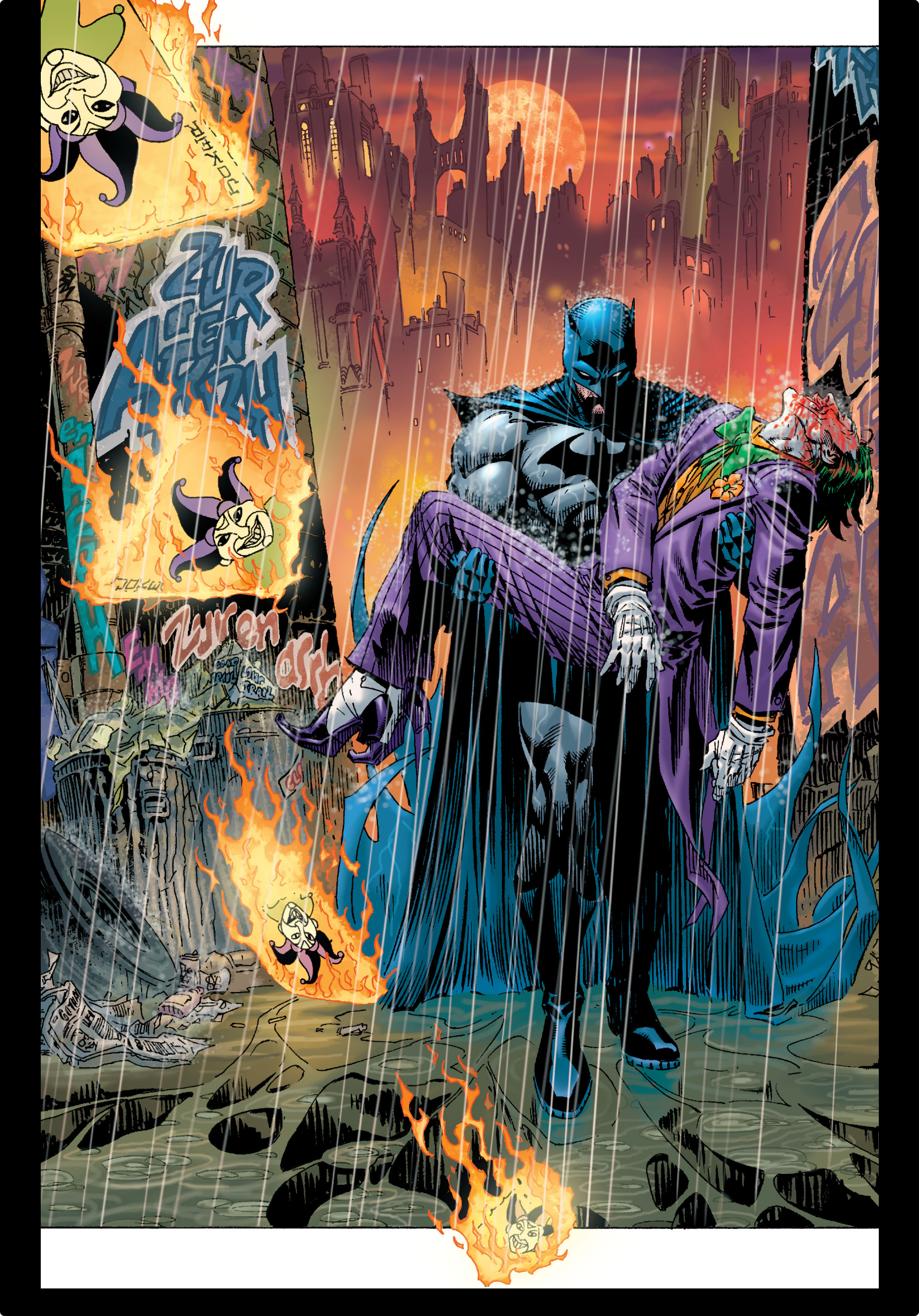
The first appearance of the phrase 'Zur En Arrh' which will reappear in the next few issues graffitied around Gotham City.  This is a trigger phrase implanted in Batman's head by our principal antagonist, Dr Hurt, intended to cause Batman's psychological collapse.
 
We also see here the bloodied Joker after being shot in the head.  Later, we will learn that the bullet to the middle of his forehead didn't kill him, but does lead to his transformation into a new version of the character.


Page 9

 
Panel 3 - Gordon says the Batman who Joker thought he had killed was an ex-cop who "just snapped".  In fact he is police officer Josef Muller, one of the 3 'ghosts of Batman', that have been manipulated by Dr Hurt.
 
Panel 5 - A key set up for Batman R.I.P. is Gordon's comments here that the newly revitalised Batman (following the Thogal ritual - see here) has essentially cleaned up Gotham.  This handily gives him space to mentor his son Damian - who at this stage he is unaware of - and pursue a romantic relationship with Jezebel Jet (yet another part of Dr Hurt's plan).  
 

Page 13

 
Panel 1 - Tim Drake joins the party.  He made his first appearance in Batman #436 in 1989.  Tim is the third person (child) to take on the role of Batman's sidekick, Robin.   He gets the gig after impressing Batman by using his detective skills to identify Bruce Wayne and Dick Grayson as the original Batman and Robin - a feat that makes Jim Gordon look even more useless, if he hasn't ever figured it out (see above).  A little unfairly, he's relegated to a bit part in Morrison's run, especially given the other Robins get time to shine; Dick Grayson becomes Batman for a while, Damian then takes over from Tim as Robin (and is a key character throughout the series), and Jason Todd gets a featured story and then a redemption arc. After Bruce Wayne's 'death' Tim adopts the new moniker of Red Robin, and his most crucial role is his instance and investigation into his belief that Bruce is still alive.  Notice he enters the Batcave here via a fireman's pole, a nod to the 60s Batman TV series.   


Panel 4 - The title of this issue's story is 'Building a Better Batmobile', and whilst that's really a metaphor for building a better Batman - Morrison's overall mission - we can see here it can also be taken literally. 

Page 14

 
Panel 2 - A perfect encapsulation of both Alfred and Bruce here; Alfred's care and attention even extends to the wild bats living in the Batcave, and Bruce - with his Batman tunnel vision - doesn't even notice.
 
Page 7 - A reiteration here that following the Thogal ritual, Batman returned so energised he ended the supervillain threat in Gotham (temporarily at least).
 

Page 15

 
The captive woman is Francine Langstrom, wife of Kirk Langstrom, aka Man-Bat - more on him below -  and despite being the damsel in distress here, has over the years transformed into She-Bat due to Kirk's serum that is being demanded by her kidnapper.  She made her first appearance in 1970's Detective Comics #402.
 
The clues to the villain's identity are all here; she's accompanied by ninjas and scientists, is using poison, has the long nails and pouty lips of a femme fatal, and refers to Batman as "my darling detective".


Page 16

 
Panel 4 -  Dr. Robert Kirkland "Kirk" Langstrom, a zoologist who specialises in bats, is better known by his alter ego Man-Bat, and made hist first appearance is Detective Comics #400 in 1970.  Langstrom developed a serum that turned him into a half-human, half-bat hybrid.  Sometimes portrayed as a villain, sometimes as an anti-hero, his serum has been used by, and on, many other characters over the years (including Batman).  Whilst Langstrom himself doesn't really feature in Morrison's Batman run after this first story arc, his serum, and those who have taken it, do continue to play an important role - particularly in the finale of Batman Incorporated.


Page 19 & 20

 
Morrison is laying out their vision here; taking the role of Alfred they're telling Batman that he's been too serious for too long, and now is the time to let Bruce Wayne back into the picture, to make Batman human again.  
 
Panel 6 - Alfred brings up the names of some of Bruce Wayne's previous girlfriends:
 
  • Kathy Kane was introduced after publication of the controversial book Seduction of the Innocent (1954) by Frederick Wertham, which suggested comic books were responsible for juvenile delinquency.  One of the many hysterical accusations was that Batman and Robin were in a homosexual relationship, and promoted homosexuality (which was obviously seen as a 'bad thing' in 50s America).  Kathy was brought in to be the very-much heterosexual love interest for Bruce, and as the first Batwoman, making her debut in 1956's Detective Comics #233.  Absent from continuity for many years, Morrison brought her back into the fold to play a significant part in Batman Incorporated.
  • Julie Madison made her debut way back in 1939's Detective Comics #1939, and has the honour of being Bruce Wayne's first romantic interest.  She was an actress, and actually got engaged to Bruce before breaking it off.  She was basically written out of continuity, until being reintroduced by Scott Snyder in 2011.
  • Vicki Vale made her debut in Batman #29 in 1948.  She is a journalist who has popped up throughout Batman continuity as a love interest - albeit being married to someone else at one point.  Despite not being used by Morrison, she does play a big part in Battle of the Cowl and Bruce Wayne: The Road Home, comics that tie into the main story but are penned by other writers. 
  • Silver St. Cloud first appeared in 1977's Detective Comics #470 as a socialite who dates Bruce Wayne, and actually figures out that he is Batman.  She has only made a handful of appearances since her debut, though she did pop up in the improbable but entertaining Batman/Elmer Fudd crossover.
The talk about past girlfriends also sets the scene for Bruce's next one: Jezebel Jet, who he (and we) will meet next issue.
 

Page 22

 
Panel 1 - Alfred wants to catch up in the latest Artemis Fowl book.  Written by Irish author Eoin Colfer, the series of children's novels features an elven police force facing off against the titular criminal mastermind.  You’d have thought he had enough of the fantasy crime fighting in his day job. 

Panel 2 - Given the scene takes place at an African fund-raiser, that must be Bono on the bottom TV screen!  Of course, U2's lead singer has a Batman connection - their song Hold Me, Thrill Me, Kiss Me, Kill Me, as well as being an absolute banger, was featured on the soundtrack of the Batman Forever film.  Bono was originally supposed to have a part in the film - as his 90s alter-ego MacPhisto - but the plan fell through, which is probably for the best.


Page 23

 
The ninja's surrounding Mrs Langstrom from earlier have now been subjected to her husband's serum, and are revealed as a new menace - Ninja Man-Bats!  The mysterious woman will be properly introduced next issue, as will the child-sized figure hidden in shadow who - unbeknown to even Grant Morrison at the time - would go on to be become a key and beloved character of the Batman universe.