Socials

Showing posts with label Batman. Show all posts

10 April 2026

Grant Morrison's Batman Annotations: Batman #658

The Give Me Comics or Give Me Death podcast is available from all your usual podcast providers, or see all episodes here

See the index for all entries in these Batman annotations here 


Batman & Son Part 4: 'Absent Fathers'


The title of Absent Fathers has multiple references in this issue, and indeed is a theme throughout the run.  The main reading of it is, of course, Bruce’s absence from Damian’s life up to this point and, the implication made at the end of the issue, that it is an absence that will continue.  There is also Bruce’s absence as a father from Tim Drake (who at this point had been adopted by Bruce).  Not only is he dealt a severe beating in his absence (by his ‘brother’), Batman then concludes the adventure without him.  Finally, there is the (literal) absence of Talia’s father, Ra’s al Ghul, who casts a shadow over the whole arc.  This portends his return in the forthcoming crossover The Return of Ra’s al Ghul. 

A fairly simple issue here, as we wrap up the Batman & Son story.  Batman arrives back at the Batcave after last issues events to find Tim Drake bludgeoned on the floor.  He rescues Alfred and has him patch up Tim, while admonishing Damian.  His newfound son tells Bruce that his mother, Talia al Ghul, will be at Gibraltar where she attempts to ransom off the Prime Minister’s wife in exchange for the military garrison there.  Batman, with Damian in tow, arrives in the nick of time and defeats her ninja Man-Bats.  Batman and Talia confront each other until the British navy destroys the submarine they are all on - leaving Batman as the apparent sole survivor.

Page 1

A great page that acts as a recap of where we are - the Prime Minister’s wife has been kidnapped by Talia, who is using Man-Bat serum to create an army of ninja Man-Bats.  Her final line “As a wife and mother, I’m sure you’ll understand” lay out the personal reasons for her whole diabolical plot - issues she will discuss with Batman in a few pages time

Page 4

Panel 3 - Damian is wearing Jason Todd’s Robin costume he took from display in the Batcave, but along with his Assassin’s League cloak. He still has a foot in both camps.  He has yet to shed his Assassin’s clothing and embrace his role as Batman’s son.


Page 7

Panel 4 - Damian is no longer in the Robin costume, but back in his League of Assassins white top.  This would make sense, as Batman would not allow him to don his sidekick’s costume as this stage.  However, there appears to be no break in the scene from the previous page where Damian is seen in the Robin outfit.  My assumption is that the last panel on page 6 was coloured incorrectly.  Here he tries to dispel Batman’s suspicions of him as a weapon of Talia sent to disrupt his operations by telling him where she is.  It’s later revealed that was exactly Talia’s plan - so he was being used by her all along, even though he didn’t realise it. 

Page 9

Panel 5 - Batman stops the destruction of Kirk Langstrom’s serum by his long-suffering wife, as he will use it as an anti-dote for Talia’s ninja Man-Bats at the end of the issue.  He will also return to Langstrom’s serums for assistance in his final showdown with Talia a few years down the road at the climax of Morrison’s Batman.


Page 11

Panel 1 - Bat-Rocket!  Here is a sign from Morrison that he re-orienting Batman away from the street level vigilante to globe-trotting super-hero.  


Page 13

Panels 2-3 - Talia is wanting to trade the wife of the Prime Minister’s wife for control of Gibraltar, which is indeed the ‘perfect tactical outpost’.  Positioned at the southern tip of Spain, it is a tiny (2.6 square miles) British colony.  Based around the Rock of Gibraltar, a large hill and fort, it overlooks the Strait of Gibraltar, the narrow waterway that separates the Atlantic Ocean from the Mediterranean Sea, and Europe from Africa.   

Page 15

Panel 2 - One of the ninjas is injecting himself with some kind of serum.  We could assume he’s just another one of Talia’s faceless, nameless henchmen.  Yet here he is given a name - Bulu - suggesting there is something different about him.  There are a coupe of meanings to the name that might be of relevance here.  It is a surname in the central and southern African Bantu-speaking people meaning strong or brave, and he is about to develop significant strength, just off the coast of Africa.  More tenuously it is the name of the underworld in Fijian mythology - and Morrison regularly uses underworld allusions for Batman.

Page 16

Panel 1 - Bulu has been transferred into a Man-Bat.  However, just like the oddity of being the only one named, we see that he is physically different from his brethren; larger, stronger, and more monstrous.  This seems to suggest Talia has been able to ‘improve’ the Man-Bat concoction and demonstrates her knowledge of genetic engineering.  This hints at the creation of the hulking nemesis, the Heretic, who wreaks havoc in Morrison’s closing storyline. 

Page 20

We get Talia’s explanation for her motives.  She wants her and Bruce to raise Damian to rule the world.  Obviously Batman cannot agree to this.  His rejection of her is the catalyst for the final third of Morrison’s run, as she seeks revenge in the worst possible way.  Poor Damian revealing he doesn’t want to choose between them, is placed in the position of every child who’s parents can’t work it out - despite being trained a world conquering assassin, he’s just a little boy who wants his family to be together.  Interestingly when Talia says ‘ours is a love story’, Bruce doesn’t deny this but states ‘it was a long time ago’ - adding more confusion as to whether Damian was conceived consensually, as earlier Bruce had claimed he was drugged.

Page 21

Panel 4 - Moments before the submarine explodes Talia activates something on her wrist.  Some kind of teleportation device?  Whatever it is, her and Damian survive.

Page 23

Obviously Batman doesn’t need teleportation devices to survive - he’s Batman!  Batman stands here holding Damian's cowl and foreshadows his own ‘death’ in Batman #681, where Dick Grayson stands holding Batman’s cowl overlooking the water and fire.


30 December 2025

Grant Morrison's Batman Annotations: Batman #657

The Give Me Comics or Give Me Death podcast is available from all your usual podcast providers, or see all episodes here

See the index for all entries in these Batman annotations here 


Batman & Son Part 3: 'Wonderboys'


The title is a play on the nickname for Robin of ‘the boy wonder’, pluralised here as we get two Robins in this story.

This fairly pedestrian issue serves primarily to introduce us to the personality of Damian, Batman’s newly revealed son.  He first challenges Batman to a fight, brushes off Tim Drake (the current Robin) when introduced, and acts the spoilt brat with Alfred.  When Batman is called out into Gotham’s sewers to deal with a kidnapping situation orchestrated by The Spook, Damian breaks out of Wayne Manor to ‘help’ and beheads the villain.  Upon returning to the Batcave he confronts and beats up Robin, before meeting his father on a rooftop and declaring himself the new Robin.
 

Page 1

Panel 3 - With his bat wing shaped eyebrows, Damian seems destined for the Wayne family.


Page 2 & 3

The Batcave.  Most artists with a run on Batman get to their Batcave shot.  Everyone seems to give it a different look and layout, but there are usually some consistent elements such as we see here; a bat-plane, a bat-boat, and trophies from Batman’s past adventures.  Given the premise of Morrison’s story is that all past continuity is canon, it’s no surprise we get some of these souvenirs:

  • The giant dinosaur is an animatronic construct originally from ‘Dinosaur Island’, a theme park, and first appeared in Batman #25 (1946).  It often ‘comes alive’ to fight off intruders to the Batcave,
  • Despite coins being usually associated withe long-standing villain Two-Face, the giant penny in the Batcave is actually a memento from Batman’s encounter with the Penny Plunderer in World’s Finest Comics #30 (1947).
  • The huge joker playing card is, unsurprisingly, a souvenir from Batman’s run-ins with arch-nemesis the Joker.  It originally appeared hung on the Joker’s wall in Detective Comics #114 (1946), in a bizarre story that revolves around acrostic poems (no, really!)

  • In the glass displays are costumes from two other members of Batman’s history - Mr Freeze’s helmet and, what looks like, the outfit of either the Roman themed Batman ally the Legionary (who is reintroduced in a few issues time) or Maxie Zeus the Greek mythology obsessed supervillain. 

Page 6

Panel 1 - Our and Damian’s introduction to Tim Drake, the third character to take on the Robin moniker and role as Batman’s sidekick/protégé, he first appeared in 1989’s Batman #436.  Drake actually worked out the true identities of Batman and Robin (Dick Grayson at the time), and was eventually picked to become Robin after the death of Jason Todd (the second Robin).  More of a detective than previous Robins, he’s an obvious choice to help introduce Damian, as their personalities are almost complete opposites.  It’s not long before Morrison moves Drake out of the larger story, so the spotlight can remain on Damian, however he plays a significant role in looking for Bruce Wayne after his ‘death’ - though mostly in other non-Morrison written Batman related comics.

Page 8

Panel 4 - These fancy alternative Batman costumes appear to be based on action figures - possibly from the Batman: The Animated Series line - however, despite trawling the internet I’ve been unable to definitively tie them to specific figures.  Anyone who can - let me know!

Page 9

Panel 1 - “What about us?”  Tim’s concern about Batman’s apparently new-found son is particularly acute because he had just been legally adopted by Bruce in Batman #654, the last issue before Morrison took over.

Page 11

Panels 3 &4 - Damian’s brattish tempter tantrum is only ended when Batman expresses anger, authority, and the codes of the martial arts.  This works because that is how Damian has been raised, and is what he’s used to.  However, throughout Morrison’s run Damian only begins to grow as a character and leave his horrific upbringing behind him when Batman, and the Bat-Family, being to treat him differently and show him there is an alternative to the way he was raised. 

Page 12

Panel 1 - The Spook - real name Val Kaliban - is a minor, rarely seen, Batman villain who made his first appearance in Detective Comics #434 (1974).  A world-class escape artist who uses those skills, along with a combination of special effects, to portray himself as a real ghost to commit crimes - predominately breaking other criminals out of prison via the underground network of tunnels that feature in this issue.  Having only made half a dozen appearances since the 70s, he’s another example of Morrison digging deep into Batman’s past.  

Panel 2 - “Over my dead body, Mister Mayor!” The Spook foreshadowing his own death a couple of pages later.  At the time of writing he remains dead, and with his bit-part history one suspects this may will be the last we see of him.  


Page 15

Panel 4 & 6 - Damian escapes the Batcave by deducing the key code from Alfred’s fingerprints, and then mimicking Tim perfectly to override the voice activated locks.  We're being shown that behind the immature exterior, Damian does possess skills well beyond his years.

Page 16

Panel 6 - Confusingly, Damian now suggests he escaped his room by killing Alfred and taking the key.  Alfred is later revealed to be fine, so how he got the key and how he really escaped is left unexplained.  

Page 18

Panel 1 - More mementos in the Batcave.  On the left is the Robin outfit worn by Jason Todd, the second Robin who was murdered by the Joker.  Next to it is the proto-Batman costume worn by Bruce’s father to a fancy dress party in Detective Comics #235 (as discussed here), and soon to be worn by Dr Hurt in Batman R.I.P.


Page 21

Panel 5 - ‘There’s a new Robin now’.  Not only does this panel herald Damian as the new Robin, but Tim’s removal from the role and adoption of the Red Robin moniker after Batman’s disappearance.  More tragically, in taking Jason Todd’s costume, Damian has damned himself to the same fate as it's previous wearer - death. 


11 October 2025

Podcast: Image Comics: The Big Dog - Jim Lee

Available from all your usual podcast providers, or listen here:  


It's all well and good talking about comics, but they are obviously a visual medium - pretty pictures!  Therefore, to accompany each episode, we also do a little blog post with some images and other extras to give you some context as to what on earth we're talking about!   

 
Mike and Lee's exploration of Image has reached Jim Lee - the business savvy, superstar of comic books. The ultimate triple threat, Jim achieved legend status at Marvel, Image and DC - but does his business acumen lack the romance of other Image founders?

GMCOGMD is an Icecream House Production, presented by Mike Bradbury and Lee Scott


 What Have We Been Reading Recently?

Batman & Robin Year One (2025)
Written by Mark Waid and Chris Samnee
Art by Chris Samnee
Colours by Matheus Lopes
Lettering by Clayton Cowles and Chris Samnee
Published by DC Comics 


We Only Found Them When They're Dead Volume 1 
Writen by Al Ewing
Art by Simione Di Meo
Colouts by Mariasara Miotti
Lettering by AndWorld Design
Published by Boom! Studios


 Jim Lee

Uncanny X-Men #268 (1990)


X-Men #1 (1991)


WildC.A.T.S. #1 (1992)


Heroes Reborn - Fantastic Four #1 (1996)


Batman: Hush - Batman #609 (2010)


20 September 2025

Grant Morrison's Batman Annotations: Batman #656


The Give Me Comics or Give Me Death podcast is available from all your usual podcast providers, or see all episodes here

See the index for all entries in these Batman annotations here 


Batman & Son Part 1: 'Man-Bats of London'


The title of the issue is a play on the (excellent) song by Warren Zevon, Werewolves of London. 

An action packed issue, where both the bigger messages and subtle hints of Morrison's work take a back seat to a lengthy fight scene mean there's not much to annotate here - but what there is, is pretty fun!  We rejoin Bruce at the fundraiser for Africa at a modern art gallery, where he flirts with potential new love interest Jezebel Jet.  The event is crashed by commando/ninja man-bats, who fight with Batman and ultimately defeat him.  He regains consciousness in the underground lair of the mastermind behind the attack - Talia al-Ghul.  But the surprises don't end there, as Talia introduces Bruce to his own son!


Page 1

Panel 1 - The bombshell introduction of Jezebel Jet.  This is her first appearance.  She is the leader of the fictional African country of Mtamba, taking over from her adoptive father (who had 'won' her in a wager) after he was killed in an uprising.  Aside from the classic super-hero love interest trait of alliteration, her name gives clues to her real agenda and the story to come.  According to the bible, Jezebel was the wife of Ahab, King of Israel, and she replaced worship of Yahweh with that of other gods (Yahweh would develop into the monotheistic God of the Abrahamic religions).  The key plot of much of Morrison's Batman is the ultimate embodiment of evil - in the form of Dr Hurt/Thomas Wayne/Darksied/The Devil - opposing and trying to destroy Batman, and there are God and Jesus allusions to Batman throughout the story.  In fact, many fans referred (usually pejoratively) to Morrison's depiction of Batman as 'Batgod' due to him displaying abilities far above his supposedly 'normal human' capabilities.  We will later discover that Jezebel is part of the Black Glove, the criminal organisation headed by Dr Hurt, so the idea of her opposing 'God' seems very much appropriate.  According to the Bible, when Jezebel purged the royal court of the Yahwists, the survivors were hidden and protected in a cave, and the Batcave plays a significant role in this Batman run.  Jezebel's biblical end sees her devoured by a pack of dogs, which mirrors the fate of Morrison's Jezebel who dies at the hands of a pack of Man-Bats.

Jezebel is also stereotypical slang for a sexually voracious African-America woman who seduces men - with its origins in the American slave trade.  Her role in the Black Glove is indeed to seduce Bruce Wayne, and she makes a startling impact on him here.  

Finally, her surname of Jet relates to the shade of black (named for the gemstone jet), and the colours of black and red will become a motif throughout the Batman R.I.P. arc - and is already a nod to her true affiliation with the Black Glove. 

Also in the background there's a pop art painting with an appropriate 'wow! wording over Jezebel's head.  Throughout the issue, there are other such paintings uncannily placed to complement the action or dialogue in the scene.    


Page 2

Panel 1 - There's a lot to unpack in this panel.  Although the artist on display is not named, the artwork is clearly in the style of Roy Lichtenstein.  Best known for his blown up replications of comic book panels, Lichtenstein has been criticised for simply being a copycat or plagiarist and failing to credit the original comic book artists - though some have suggested that this itself was purposeful, and a reference to DC themselves failing to credit artists in the original comics.  He did use a lot of panels from DC, which begs the question whether he exists in the DC Universe, despite using that same fictional universe as the basis for his art?  It's a quintessentially Morrison meta-textual question that is thrown in here.

Bruce says that all the comic book stuff is 'way too highbrow for me', and there are multiple ways this can be taken.   Art critics have claimed that Lichtenstein elevated low art, comics, into high art by turning them into giant paintings.  It could be Morrison taking a dig at those that do indeed consider comics to be low art, or they could be suggesting that comics - and Morrison's particularly - are, or should be, considered highbrow.  Certainly, Morrison is one of the few comic writers whose work is often elevated by fans and critics to being 'highbrow'.

This is followed up by Bruce's claim that he collects 'tribal art, schizophrenic artists, "outsider" work'.  Usually any art on display at Wayne Manor is depicted as traditional portraiture, so it's not clear whether he's talking about actual art here.  More likely, this is a reference to his alter ego's regular run-ins with his rogue's gallery (literally, in this reference).  Though the mention of 'tribal' anticipates the events of The Return of Bruce Wayne, in which ancient tribes play a major role.  'Outsider' is also a nod to the superhero team of the same name, founded by Batman, who also make an appearance later on in Morrison's Batman.


Panel 2 - 'There's a message here somewhere.  I know if I just stare hard enough..'  Many people often criticise Morrison's comics as confusing, or not making sense, or missing important information.   Final Crisis, which plays a part in this Batman story, in particular has faced these criticisms.  Morrison's defence is that all the information is there on the page, you just need to apply more thought and attention to detail to it than you might other comics.

Panel 3 - More of the Lichtenstein-style pop art, including what looks like a panel from a Sgt. Rock comic.  Sgt. Rock, a US army officer who has starred in many DC comics, was co-created in 1959 by the legendary artist Joe Kubert - who just happens to be the father of the artist of this comic, Andy Kubert. 

The centrepiece of the exhibition is a giant Godzilla-type dinosaur in formaldehyde.  This is a nod to the star of the Young British Artist movement, Damien Hirst, who's most famous works were animals, sometimes cut in half, preserved in formaldehyde.   Of course, he's not the only Damien that pops up in this issue.  The dinosaur is also reminiscent of the giant T-Rex robot that is kept in the Batcave.  Morrison is tipping us off that Batman's life is about to be turned upside down.

The detailed figures in the foreground appear to be famous guests at the exhibition.  The arched eyebrows, receding hairline, and sunglasses, suggest Jack Nicholson at the front.  If anyone can identify the others, then please let me know.  Though, the short man with the gray hair does bring a young Jack Kirby to mind.


Page 3

Panel 1 - That appears to be Grant Morrison themselves, with the trademark bald head and sunglasses.  Morrison has a reputation for inserting themselves into their comics, most famously Animal Man.   The artwork of clowns may be a reference to the Joker, though it seems a bit on the nose.


Panel 2 - More famous people.  Jezebel refers to 'the Prime Minister's wife', and the woman here does indeed bear an uncanny resemblance to Cherie Blair, the wife of former British Prime Minister Tony Blair (he was still PM when this issue was published).  Though Jezebel also refers to 'Darius Cage, the film director', the man on the left with the wild hair looks an awful lot like a different film director, Michael Bay.  Again, if anyone can identify the others in this panel, please let me know!


Page 9

Panel 5 - When thinking of an 'Aunt' in Batman, I'm sure most of us would conjure up Aunt Harriet from the 60s TV show.  She was in fact originally from the comics, and was Dick Grayson's aunt rather than Bruce's.  Instead, here we have Aunt Agatha who is Bruce's Aunt, being his father's sister.  She made her debut in 1955's Batman #89.  Despite Batman R.I.P. revolving around an alleged Thomas Wayne back from the dead, she plays no part in the story other than this one panel - but she serves again as a reminder that in Morrison's Batman everything from past continuity is in play.


Page 19

Panel 4 - Batman and Talia have differing versions of what occurred when Damien was conceived - but there's also a big difference between Batman's version and the original story in Batman: Son of the Demon, see here for more details.

Page 20

Panel 4 - Talia departs with the promise that Batman will hear from her again soon, and that she intends to 'hold the world hostage to a new kind of terror'.  She is true to her word, and what she has planned is the basis of the last third of Morrison's run with Batman Incorporated. 

Page 21

Finally, we discover who the son in Batman and Son is.  Meet Damien Wayne.  A character devised by Morrison to originally be part of one story arc and then be killed off.  Despite initial hostility to the character from certain sections of the Batman fan base, he grew to become a fan favourite.  The initial plans for the character were scrapped, and Damien went on to play a major role in the entire Morrison Batman saga.  Despite death and continuity changes, he continues to be a major player in the Batman comics as another Robin.

Damien derives from the Greek 'Damianos', which means 'to conquer'.  And this Damien was raised by his mother to rule the world, so nothing could be more appropriate.  The other obvious connection is with Damien from The Omen.  In that film, Damien is the antichrist, the son of Satan, and seems destined to rule the world.  Not only does that connect with this Damien's al Ghul family line - their name translating to 'head of the demon' - and again connects with his mother's plan for world domination, but it also ties in with the biblical themes of the devil vs God, good vs evil, of Batman R.I.P.


9 July 2025

Grant Morrison's Batman Annotations: Batman #655

The Give Me Comics or Give Me Death podcast is available from all your usual podcast providers, or see all episodes here

See the index for all entries in these Batman annotations here 


Batman & Son Part 1 - 'Building a Better Batmobile'


Having seemingly won the battle over supervillainy in Gotham, Batman is persuaded to spend more time as Bruce Wayne.  Flying over to London to attend a fundraiser, he is drawn into a plot by an unknown woman involving Man-Bat and a mysterious child.

Page 1

 
The man falling from the building, having suffered poisoning from Joker gas, is Jim Gordon.  He made his first appearance in Batman's first ever comic, Detective Comics #27, and has been an ally and sometime confidant of Bruce Wayne and Batman ever since.  Generally holding the position of Commissioner of Gotham's police department, he has over the years been a Detective, a Captain, and retired.  It is often implied that he knows Bruce is Batman, but keeps the secret to himself - and he would have to be the worst police detective of all time not to have figured it out.  He is the father of Barbara Gordon, one-time Batgirl and then superhero information broker Oracle.  Despite the longstanding and deep relationship the character has with Batman, he plays a fairly minor supporting role in Morrison's Batman run.  

Page 2 & 3

 
A triumphant Joker leans over an apparently dead Batman with his bloodied crowbar.  We will shortly see that this isn't in fact Batman (nor is he in fact dead), but in the first pages of the run Morrison is already foreshadowing not only the 'death' of Batman that occurs later on, but their use of the crowbar (which is the weapon with which the Joker killed Jason Todd, the second Robin) also anticipates both the return of Jason Todd and the death of another Robin.  

The representation of the Joker here is very traditional, including the Joker-faced helicopter, and sets the scene for the Joker's own story of transformation.  He's bragging of killing Batman in front of a load of vulnerable disabled kids, to emphasise both his evilness and his absurdness.  Though his gloating of Batman's apparent death does seem at odds with his commentary in Batman R.I.P. that he and Batman need each other, and that his aim is Batman's psychological, not physical, destruction.  


Page 4

 
Panel 6 - The obvious indication that this isn't the real Batman, as Bruce Wayne doesn't use guns or kill.  Rules he would actually break during this run as part of Final Crisis where he shoots and 'kills' the god Darkseid.


Page 6

 
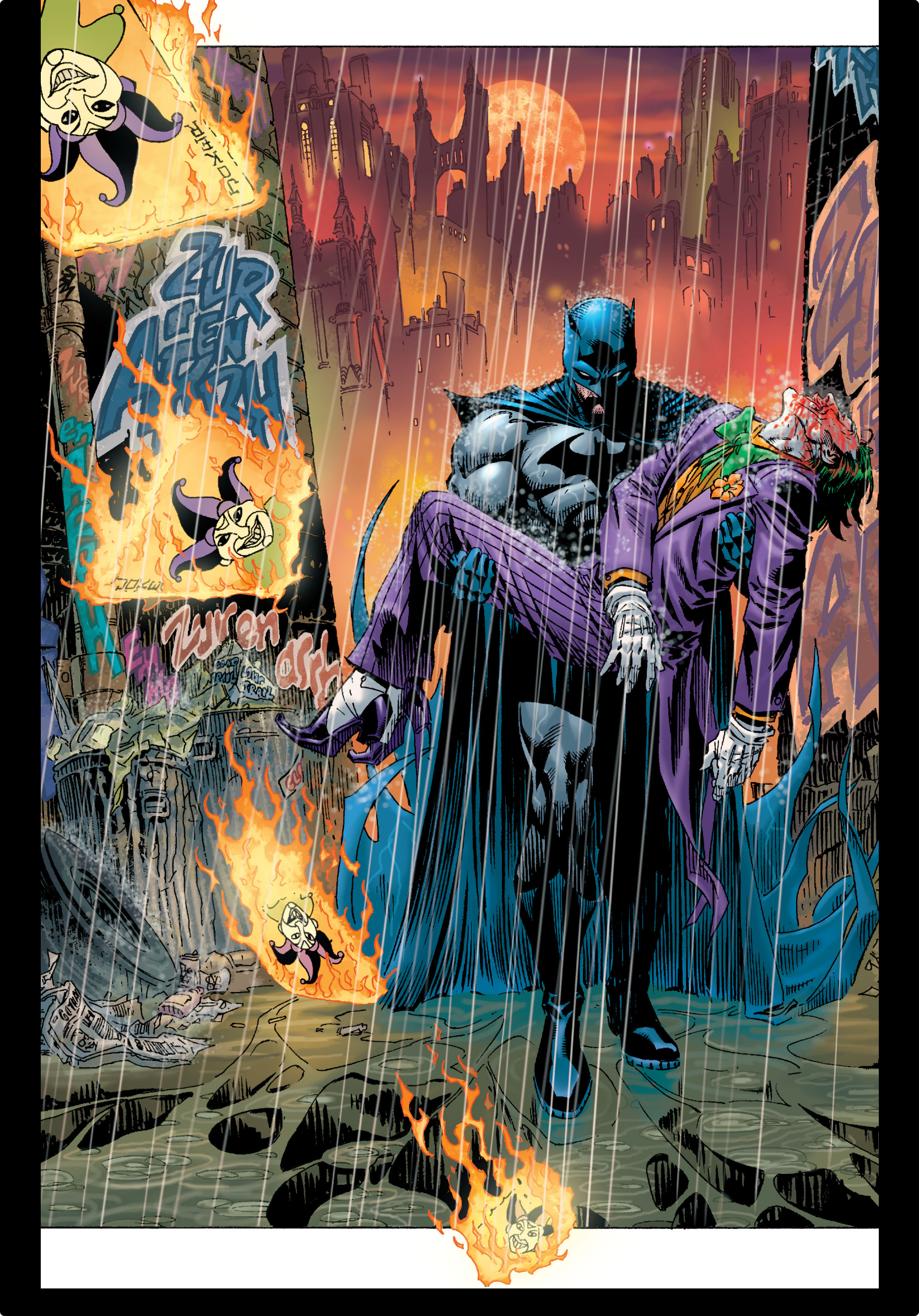
The first appearance of the phrase 'Zur En Arrh' which will reappear in the next few issues graffitied around Gotham City.  This is a trigger phrase implanted in Batman's head by our principal antagonist, Dr Hurt, intended to cause Batman's psychological collapse.
 
We also see here the bloodied Joker after being shot in the head.  Later, we will learn that the bullet to the middle of his forehead didn't kill him, but does lead to his transformation into a new version of the character.


Page 9

 
Panel 3 - Gordon says the Batman who Joker thought he had killed was an ex-cop who "just snapped".  In fact he is police officer Josef Muller, one of the 3 'ghosts of Batman', that have been manipulated by Dr Hurt.
 
Panel 5 - A key set up for Batman R.I.P. is Gordon's comments here that the newly revitalised Batman (following the Thogal ritual - see here) has essentially cleaned up Gotham.  This handily gives him space to mentor his son Damian - who at this stage he is unaware of - and pursue a romantic relationship with Jezebel Jet (yet another part of Dr Hurt's plan).  
 

Page 13

 
Panel 1 - Tim Drake joins the party.  He made his first appearance in Batman #436 in 1989.  Tim is the third person (child) to take on the role of Batman's sidekick, Robin.   He gets the gig after impressing Batman by using his detective skills to identify Bruce Wayne and Dick Grayson as the original Batman and Robin - a feat that makes Jim Gordon look even more useless, if he hasn't ever figured it out (see above).  A little unfairly, he's relegated to a bit part in Morrison's run, especially given the other Robins get time to shine; Dick Grayson becomes Batman for a while, Damian then takes over from Tim as Robin (and is a key character throughout the series), and Jason Todd gets a featured story and then a redemption arc. After Bruce Wayne's 'death' Tim adopts the new moniker of Red Robin, and his most crucial role is his instance and investigation into his belief that Bruce is still alive.  Notice he enters the Batcave here via a fireman's pole, a nod to the 60s Batman TV series.   


Panel 4 - The title of this issue's story is 'Building a Better Batmobile', and whilst that's really a metaphor for building a better Batman - Morrison's overall mission - we can see here it can also be taken literally. 

Page 14

 
Panel 2 - A perfect encapsulation of both Alfred and Bruce here; Alfred's care and attention even extends to the wild bats living in the Batcave, and Bruce - with his Batman tunnel vision - doesn't even notice.
 
Page 7 - A reiteration here that following the Thogal ritual, Batman returned so energised he ended the supervillain threat in Gotham (temporarily at least).
 

Page 15

 
The captive woman is Francine Langstrom, wife of Kirk Langstrom, aka Man-Bat - more on him below -  and despite being the damsel in distress here, has over the years transformed into She-Bat due to Kirk's serum that is being demanded by her kidnapper.  She made her first appearance in 1970's Detective Comics #402.
 
The clues to the villain's identity are all here; she's accompanied by ninjas and scientists, is using poison, has the long nails and pouty lips of a femme fatal, and refers to Batman as "my darling detective".


Page 16

 
Panel 4 -  Dr. Robert Kirkland "Kirk" Langstrom, a zoologist who specialises in bats, is better known by his alter ego Man-Bat, and made hist first appearance is Detective Comics #400 in 1970.  Langstrom developed a serum that turned him into a half-human, half-bat hybrid.  Sometimes portrayed as a villain, sometimes as an anti-hero, his serum has been used by, and on, many other characters over the years (including Batman).  Whilst Langstrom himself doesn't really feature in Morrison's Batman run after this first story arc, his serum, and those who have taken it, do continue to play an important role - particularly in the finale of Batman Incorporated.


Page 19 & 20

 
Morrison is laying out their vision here; taking the role of Alfred they're telling Batman that he's been too serious for too long, and now is the time to let Bruce Wayne back into the picture, to make Batman human again.  
 
Panel 6 - Alfred brings up the names of some of Bruce Wayne's previous girlfriends:
 
  • Kathy Kane was introduced after publication of the controversial book Seduction of the Innocent (1954) by Frederick Wertham, which suggested comic books were responsible for juvenile delinquency.  One of the many hysterical accusations was that Batman and Robin were in a homosexual relationship, and promoted homosexuality (which was obviously seen as a 'bad thing' in 50s America).  Kathy was brought in to be the very-much heterosexual love interest for Bruce, and as the first Batwoman, making her debut in 1956's Detective Comics #233.  Absent from continuity for many years, Morrison brought her back into the fold to play a significant part in Batman Incorporated.
  • Julie Madison made her debut way back in 1939's Detective Comics #1939, and has the honour of being Bruce Wayne's first romantic interest.  She was an actress, and actually got engaged to Bruce before breaking it off.  She was basically written out of continuity, until being reintroduced by Scott Snyder in 2011.
  • Vicki Vale made her debut in Batman #29 in 1948.  She is a journalist who has popped up throughout Batman continuity as a love interest - albeit being married to someone else at one point.  Despite not being used by Morrison, she does play a big part in Battle of the Cowl and Bruce Wayne: The Road Home, comics that tie into the main story but are penned by other writers. 
  • Silver St. Cloud first appeared in 1977's Detective Comics #470 as a socialite who dates Bruce Wayne, and actually figures out that he is Batman.  She has only made a handful of appearances since her debut, though she did pop up in the improbable but entertaining Batman/Elmer Fudd crossover.
The talk about past girlfriends also sets the scene for Bruce's next one: Jezebel Jet, who he (and we) will meet next issue.
 

Page 22

 
Panel 1 - Alfred wants to catch up in the latest Artemis Fowl book.  Written by Irish author Eoin Colfer, the series of children's novels features an elven police force facing off against the titular criminal mastermind.  You’d have thought he had enough of the fantasy crime fighting in his day job. 

Panel 2 - Given the scene takes place at an African fund-raiser, that must be Bono on the bottom TV screen!  Of course, U2's lead singer has a Batman connection - their song Hold Me, Thrill Me, Kiss Me, Kill Me, as well as being an absolute banger, was featured on the soundtrack of the Batman Forever film.  Bono was originally supposed to have a part in the film - as his 90s alter-ego MacPhisto - but the plan fell through, which is probably for the best.


Page 23

 
The ninja's surrounding Mrs Langstrom from earlier have now been subjected to her husband's serum, and are revealed as a new menace - Ninja Man-Bats!  The mysterious woman will be properly introduced next issue, as will the child-sized figure hidden in shadow who - unbeknown to even Grant Morrison at the time - would go on to be become a key and beloved character of the Batman universe.